New Publications in Comet Research: Numerical Approaches to Environment Modelling and Observation Interpretation
Two scientific papers involving Ventspils University of Applied Sciences and the Ventspils International Radio Astronomy Centre (VIRAC) have recently been published. They offer new numerical approaches to modelling the cometary environment and interpreting observations. These studies strengthen the research capacity of Ventspils University of Applied Sciences and Latvia’s involvement in international science, as they develop modern computing technologies for the needs of astronomy.
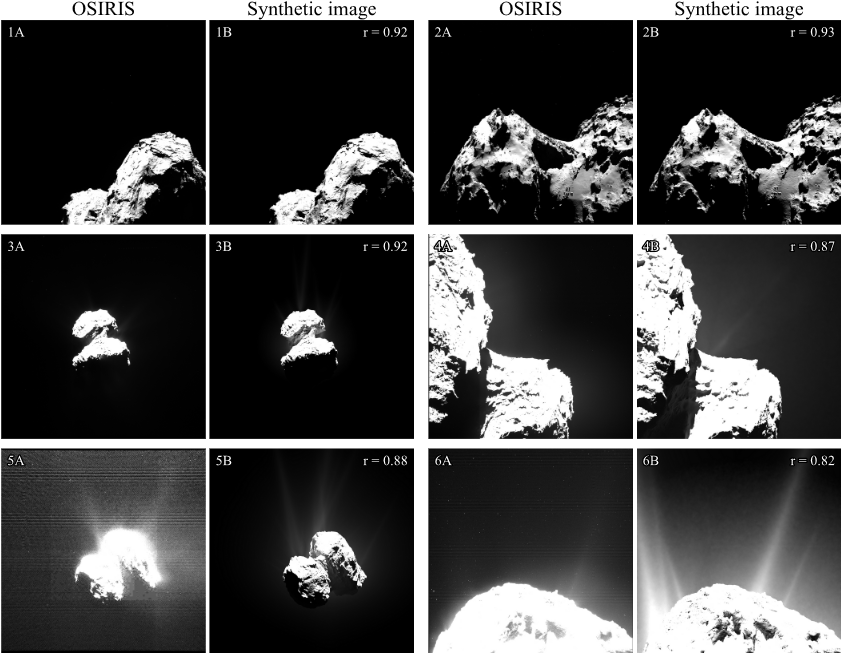
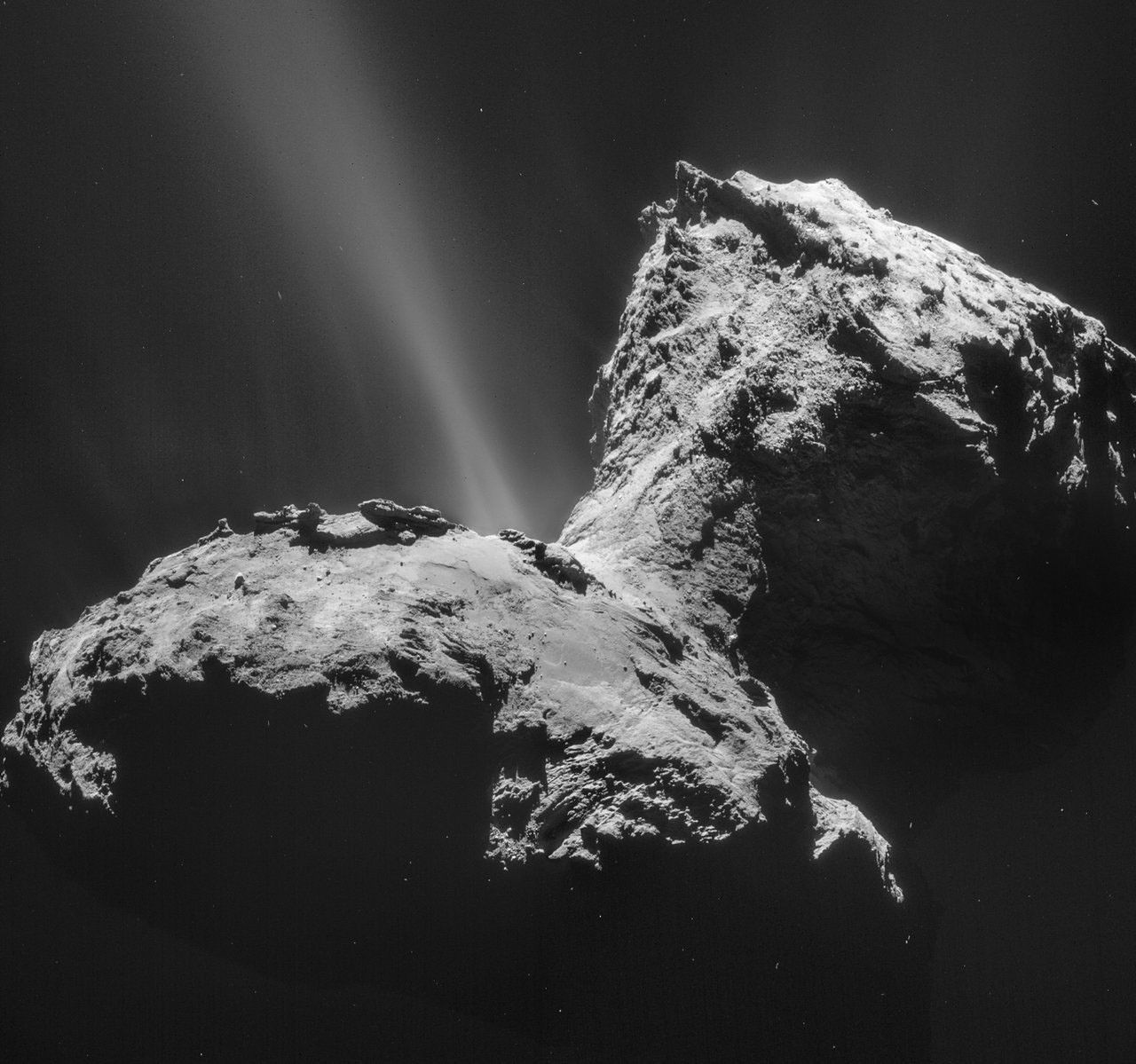
The first article, “A physics-informed framework for synthetic flyby imaging of activity in dynamically new comets”, led by Gints Jasmonts, was recently published in Monthly Notices of the Royal Astronomical Society. The study presents a modular framework for generating synthetic spacecraft observations of previously unexplored comets by combining models of the nucleus, surrounding dust coma and localized jet activity with realistic observing geometry. This ability to work with poorly constrained targets is particularly relevant to ESA’s Comet Interceptor mission, which is intended to encounter a dynamically new and potentially previously undiscovered comet. Because the properties and activity of such a target cannot be known far in advance, mission and instrument-planning scenarios must account for a wide range of possible cometary environments, which a simulated environment can explore. The approach was evaluated against independent thermophysical models and calibrated observations from ESA’s Rosetta mission. The implementation is built around Blender and publicly available activity modelling tools, while its modular structure allows individual components to be replaced or extended for different applications.
Link to article: https://academic.oup.com/mnras/article/551/4/stag1556/8762610
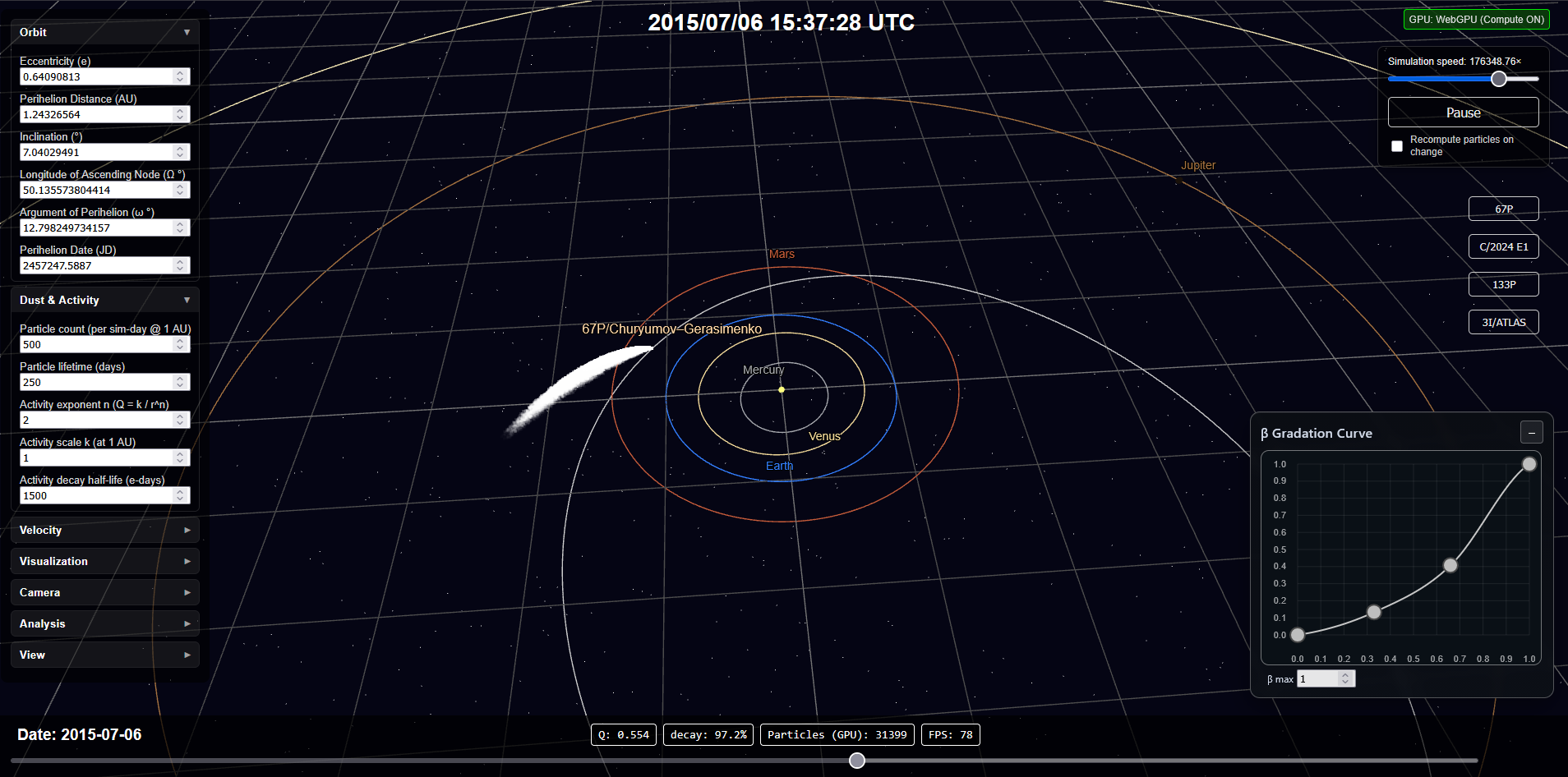
The second article, “A Browser-Based Three-Dimensional Simulator for Comet Dust Tail Modeling”, by Miks Balodis, Gints Jasmonts, Ali Arshad and Andris Slavinskis, has been published in Astronomy and Computing, with the developed software available online. It presents a GPU-accelerated simulator capable of modelling and visualising comet dust tails directly in a web browser in real time. Using WebGPU, the developed tool can interactively propagate and display millions of simulated dust particles while remaining suitable for rapid exploration of different comet and dust parameters. The simulator was compared with telescope observations of several comets as well as the established COMTAILS model, demonstrating agreement with the principal direction, width and extent of observed dust tails. The simulator, comparison tools and validation scripts are also openly available for further use and development.
Link to article : https://www.sciencedirect.com/science/article/pii/S2213133726001423
Together, the two studies address different scales of the comet environment: from activity close to the nucleus and its appearance to spacecraft instruments, to the large-scale dust tail observable from Earth. Both approaches are designed with computational efficiency and flexibility in mind, allowing models to be adapted to newly discovered objects for which only limited observational information may initially be available. This is particularly relevant for future missions and for rapidly discovered long-period or interstellar objects such as the interstellar comet 3I/ATLAS, which was also used as a hyperbolic-orbit validation case for the developed dust-tail simulator.
The published research uses numerical modelling and optical observations and arises from radio astronomical studies of comets in VIRAC, including use of interferometric networks. In the latter, several telescopes are combined in a single observational system. The most accessible such system is the European Very Large Baseline Interferometry Network EVN, administered through the JIV-ERIC consortium, part of which is also Latvia.
Author: Gints Jasmonts
VIRAC Research assistant
This information has been prepared within the framework of the project “Ventspils University of Applied Sciences` International Cooperation and Innovation for the Development of Latvia’s Smart Specialisation” (Project No. 1.1.1.5/3/25/I/012).
Share on other platforms
Other news