Scientific Seminar Held on the Mystery of the Andromeda Galaxy’s Double Nucleus

November 24, 2026

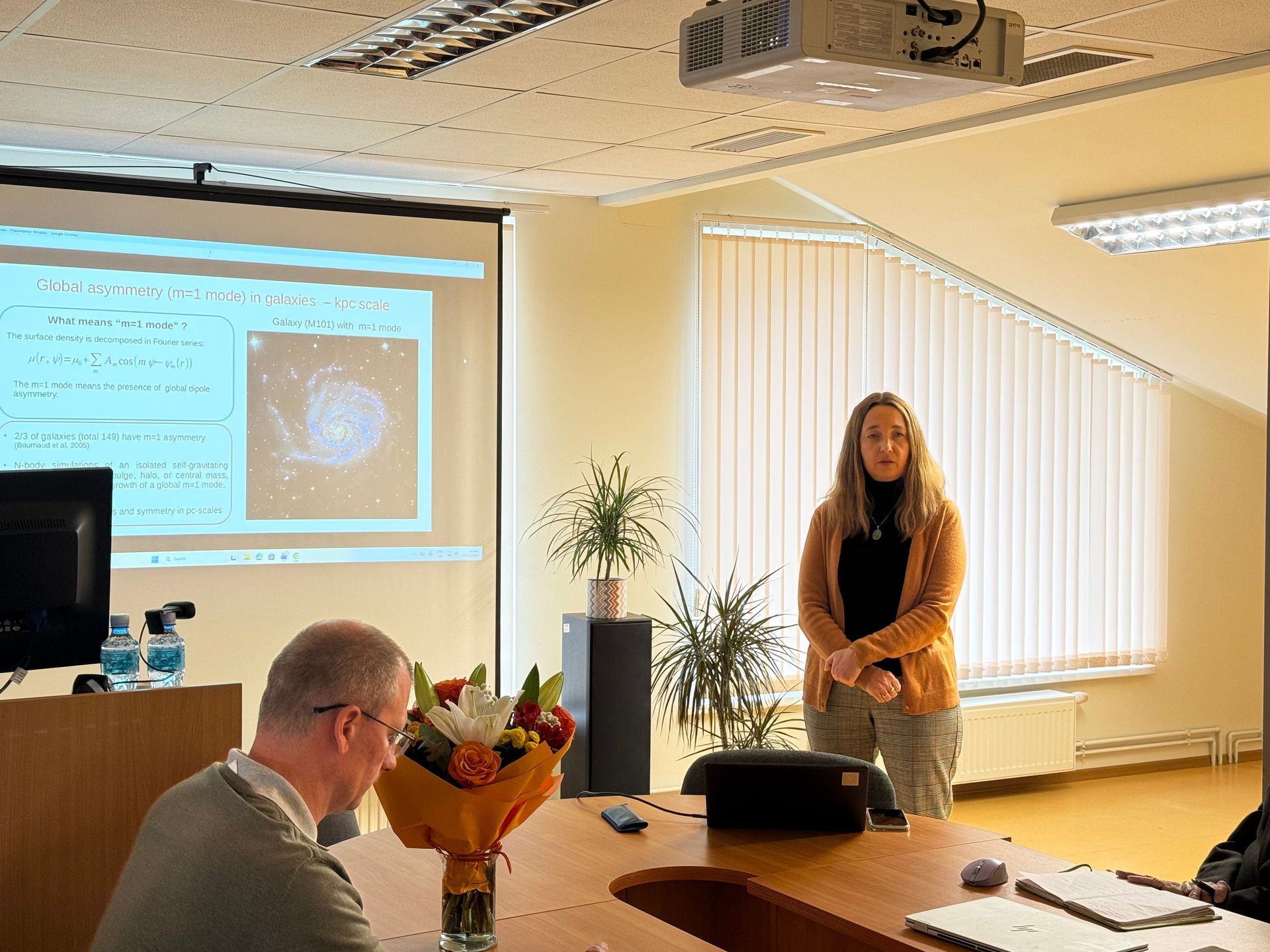
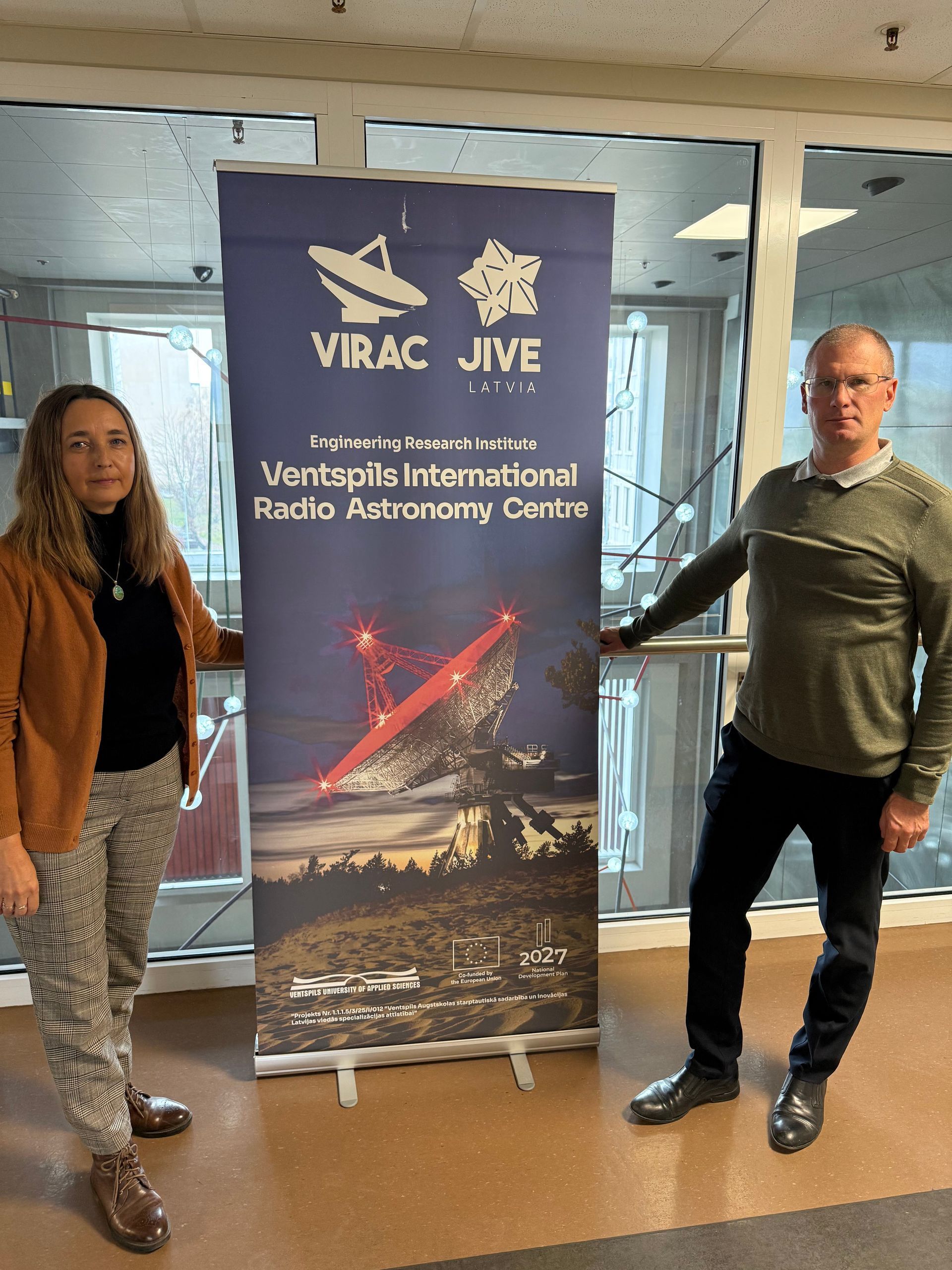
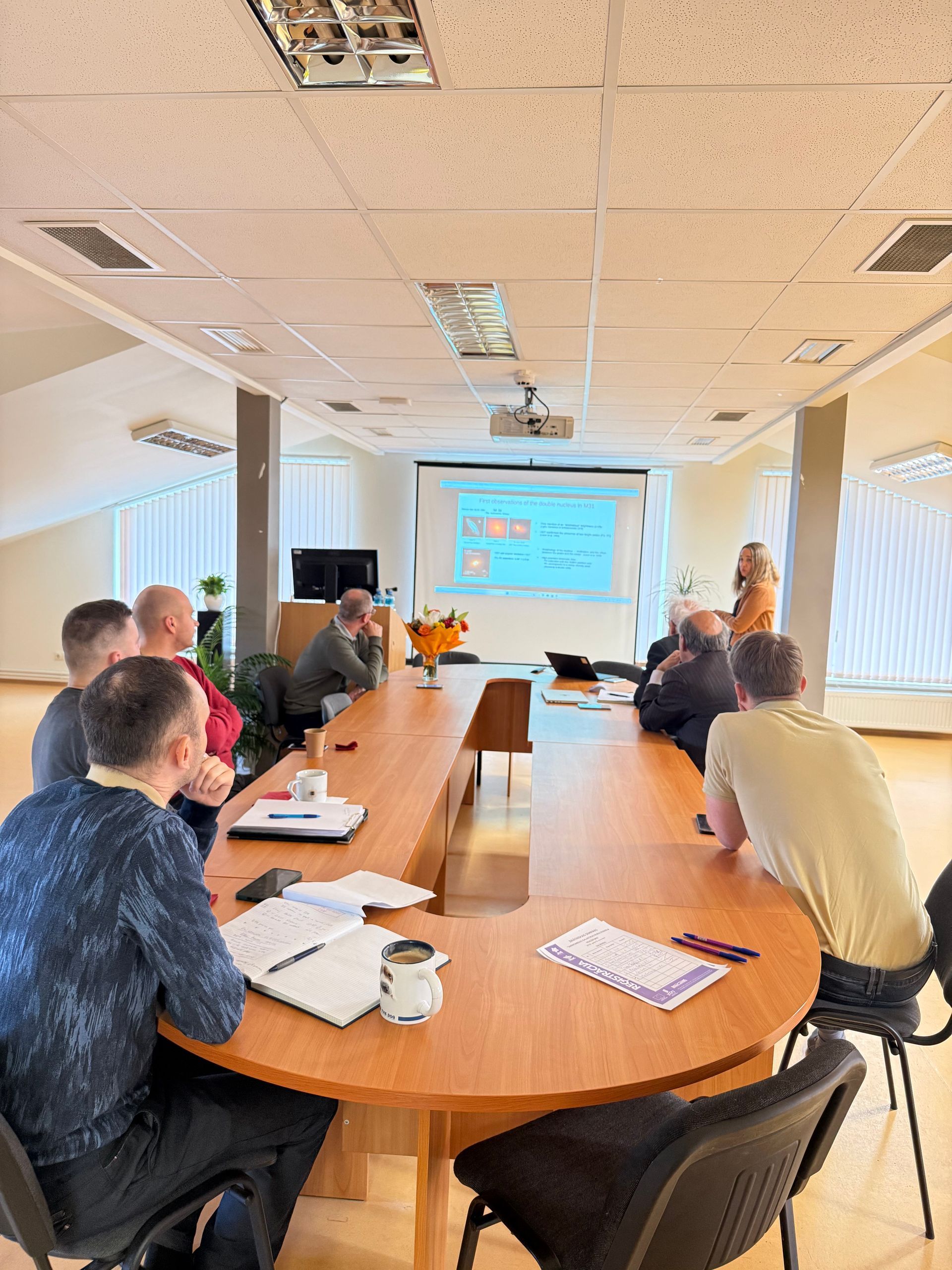
On November 13, 2026, Prof. Elena Bannikova visited Ventspils University of Applied Sciences, where, at a scientific seminar organized by the Ventspils International Radio Astronomy Centre (VIRAC), she presented the latest research findings on one of the most intriguing questions in modern galactic dynamics – the unusual double-nucleus structure of the Andromeda Galaxy (M31).


The seminar was organized as part of the JIV-ERIC Latvia consortium activities, fostering international scientific collaboration in the fields of radio astronomy, astrophysics, and galaxy evolution research. During the event, participants had the opportunity to explore the latest theoretical models and numerical simulations that help explain the processes occurring in the vicinity of supermassive black holes.


Prof. Elena Bannikova is currently affiliated with the INAF – Astronomical Observatory of Capodimonte in Italy, as well as the Institute of Radio Astronomy of the National Academy of Sciences of Ukraine. Her research interests encompass the dynamics of galactic nuclei, the interaction of supermassive black holes with surrounding stellar systems, and high-resolution numerical simulations in astrophysics.


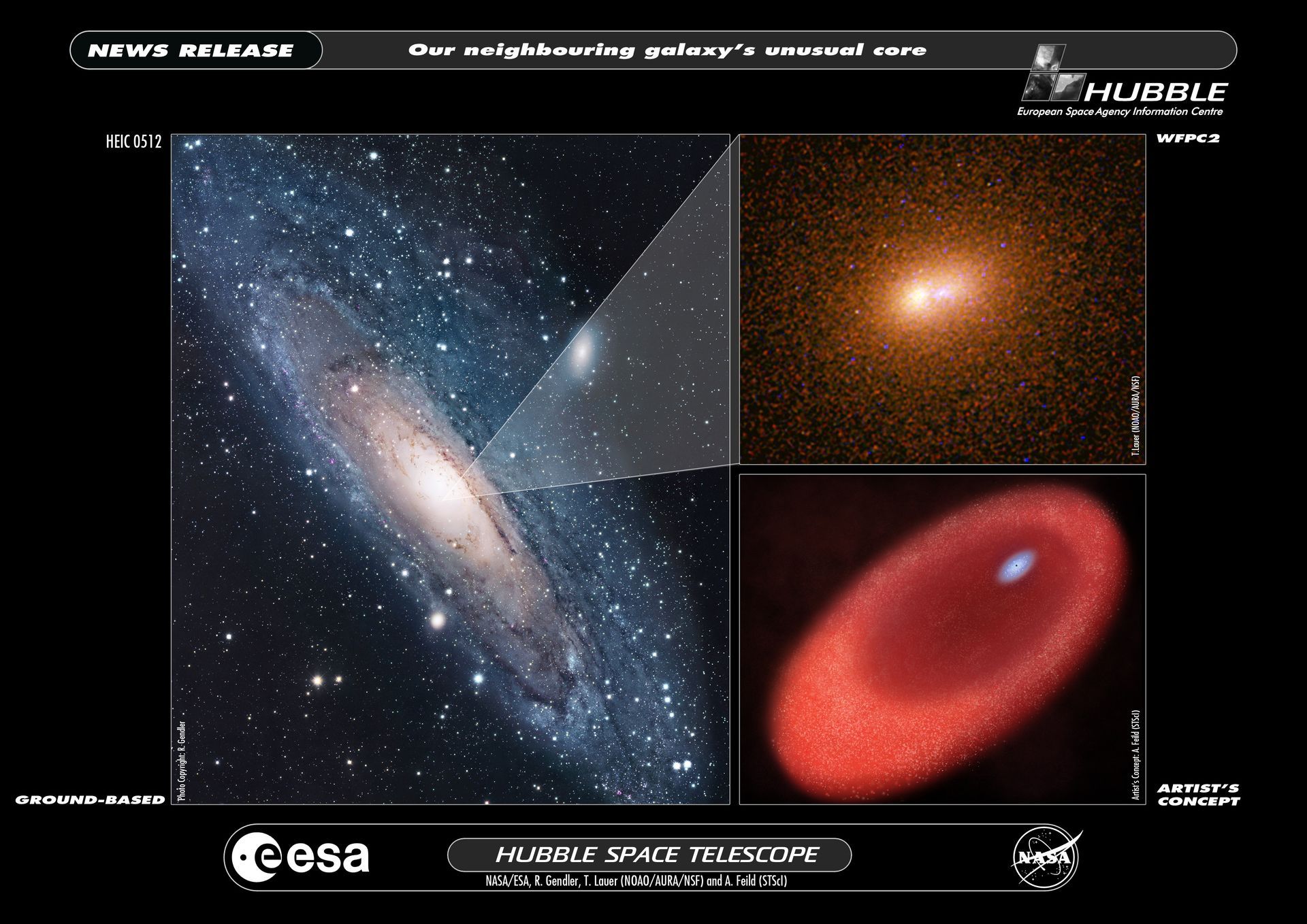
The central topic of the seminar was the double nucleus of the Andromeda Galaxy, which has attracted the attention of astronomers for several decades. Historic observations with the Hubble Space Telescope revealed two brightness peaks at the center of the galaxy, raising questions about the origin of such an unusual structure.


The presentation highlighted a recently published study in the journal
Astronomy & Astrophysics utilizing high-resolution N-body simulations. The study’s findings indicate that in thick stellar structures surrounding supermassive black holes, an asymmetric stellar distribution can form spontaneously without external perturbations. This process creates a long-lived asymmetry and can explain the observed double-nucleus structure in the Andromeda Galaxy.


The study also demonstrated that such an asymmetric mass distribution can cause an offset of the supermassive black hole relative to the system's center of mass. Calculations suggest that in the Andromeda Galaxy, this offset could potentially reach approximately six milliarcseconds, which in the future could become an observable effect using high-precision radio interferometry methods.


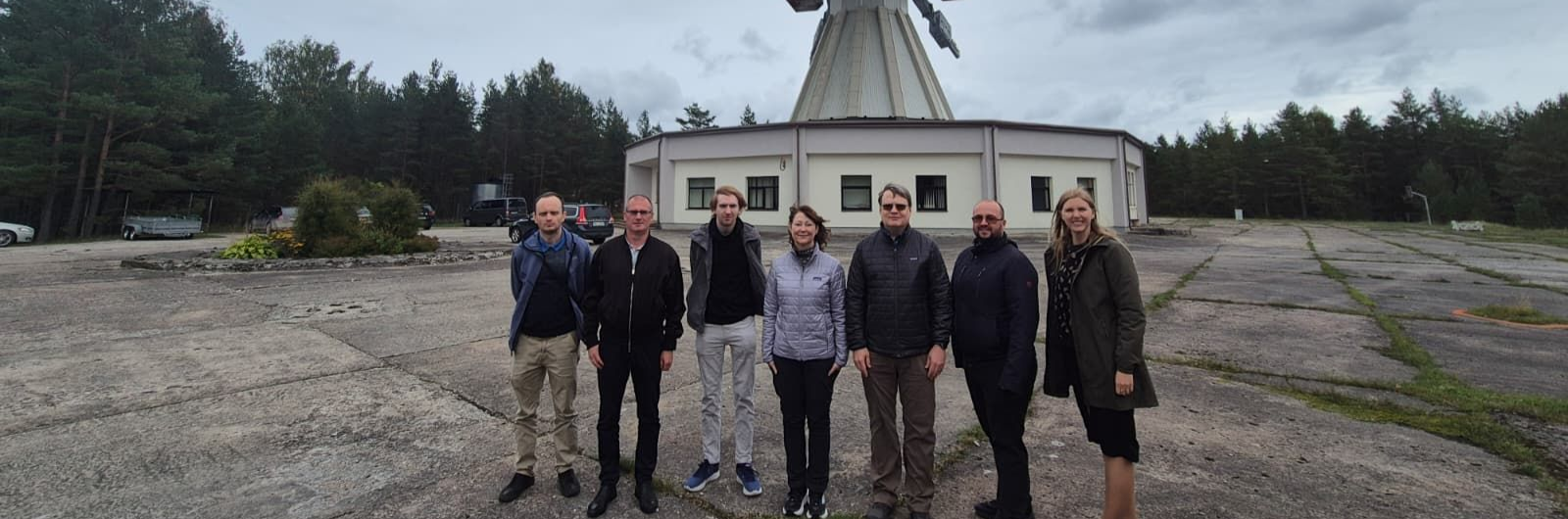
The event brought together researchers, students, and astronomy enthusiasts, encouraging discussions on galactic nucleus dynamics, observations of supermassive black holes, and future opportunities in radio astronomy. In addition to the seminar, guests had the opportunity to tour VIRAC’s infrastructure in Irbene, including its radio telescope complex, which is one of the most significant radio astronomy research infrastructures in the Baltic region.


Presentation is available HERE.

Publication: https://www.aanda.org/component/article?access=doi&doi=10.1051/0004-6361/202660388


This information has been prepared within the framework of the project “Ventspils University of Applied Sciences` International Cooperation and Innovation for the Development of Latvia’s Smart Specialisation” (Project No. 1.1.1.5/3/25/I/012). 
Share on other platforms

Other news
By Rota Žagare • November 24, 2026
On 27 November and 8–9 December 2026, Ventspils University of Applied Sciences invites representatives from research and education, business, public administration and civil society to participate in the CoLab “Who Will Work for Companies in 2035?” to explore future workforce challenges and potential solutions for regional economic development. Register HERE: https://fienta.com/lv/kurzemes-biznesa-forums The growing workforce challenge Labour shortages are becoming an increasingly significant challenge across Europe. An ageing population, changing skills requirements and technological transformation are affecting companies’ ability to recruit employees and plan for future growth. The European Commission highlights skills development, working conditions, workforce participation and labour mobility as important areas for addressing these challenges. Meanwhile, the OECD emphasises that labour shortages differ between regions and can limit business development, investment and economic growth. Attracting and retaining talent The question of who will work for companies in 2035 goes beyond the number of available employees. It also concerns the attractiveness of regions as places to live, work and build a career. Employment opportunities, housing, education, public services, career development and quality of life all influence where people choose to live. According to the OECD, Latvian regions have experienced population decline over the past two decades. For the Kurzeme region, this highlights the importance of cooperation between businesses, municipalities and educational institutions. How can we encourage graduates to stay in the region, attract new residents and motivate people to return? Skills and technologies of the future As technologies and business models evolve, companies need employees with new skills and competencies. Cooperation between educational institutions and employers is therefore essential to ensure that education and training meet future labour market needs. Artificial intelligence (AI), robotics and automation are also transforming the workplace. According to the OECD, AI can change the tasks employees perform, create new opportunities and increase productivity, while also introducing new skills requirements. In Latvia, the Ministry of Economics’ labour market forecasts for 2030 and 2040 provide a valuable starting point for discussing potential workforce challenges in 2035. Exploring potential solutions There is no single solution to labour shortages. The CoLab will explore three interconnected approaches: Attracting and retaining local employees – improving working conditions, developing skills and retaining regional talent. Recruiting international employees – exploring opportunities and challenges related to attracting and integrating workers from abroad. Investing in automation and AI – improving productivity, reducing repetitive tasks and adapting to workforce shortages through technology. Companies may benefit from combining these approaches according to their individual needs and long-term development goals. Bringing different perspectives together The CoLab aims to bring together representatives from Ventspils State City Municipality, the Ministry of Economics, the Latvian Chamber of Commerce and Industry (LTRK), the Employers’ Confederation of Latvia (LDDK), MILA and businesses to share insights, practical experiences and potential solutions. Through interdisciplinary discussions and cooperation, participants will explore how businesses, educational institutions and public administration can work together to address future workforce challenges.
By Rota Žagare • November 23, 2026
On 25 November, from 10:00 to 12:00 (EET), Ventspils University of Applied Sciences (VUAS) invites participants to join the international MarTe project's online webinar, “From Marine Data to Confident Decisions – Planning and Testing in the Baltic Sea”. During the webinar, experts from Latvia and Estonia will share their experience in marine technology testing, the use of digital tools, and the importance of environmental data in informed decision-making.  The webinar will take place within the framework of the MarTe project and aims to promote the exchange of knowledge and experience in marine technology development and testing in the Baltic Sea region. Participants will have the opportunity to learn how marine environmental data, modelling methods, and digital solutions can help plan technology testing more effectively, assess potential risks, and make data-driven decisions. The webinar programme will feature three expert presentations: Introduction to Testbeds for Marine Technologies. Anda Ikauniece, researcher at the Latvian Institute of Aquatic Ecology, will introduce the fundamental principles and requirements for establishing marine technology testbeds and assessing technology readiness for testing. Ice Modelling in the Baltic Sea. Ilja Maljutenko, researcher at Tallinn University of Technology, will explain how forecasting and modelling ice conditions can support safer and more efficient planning of marine operations and testing of new technologies. From Marine Evidence to Site Decisions. Jonne Kotta, professor at the University of Tartu, will demonstrate two digital tools that use marine environmental data to identify the most suitable locations for testing new technologies. The event programme is available here: https://marinetechub.eu/news-and-events/events/soft-skills-webinar-marine-data-confident-decisions Registration form: https://forms.gle/M8cTDg3HUucEwnFy5
By Rota Žagare • November 10, 2026
On November 13, 2026, the Ventspils International Radio Astronomy Centre (VIRAC) at Ventspils University of Applied Sciences (VUAS) will host a scientific seminar entitled “The Mystery of the Double Nucleus in the Andromeda Galaxy”, led by researcher prof.Elena Bannikova. The seminar is organised as part of the JIVE Latvia consortium activities, fostering international scientific collaboration and knowledge exchange in radio astronomy and astrophysics. The Andromeda Galaxy is one of the closest major galaxies to our Milky Way, yet its centre remains a fascinating astronomical mystery. Observations have revealed an unusual double-nucleus structure, raising intriguing questions about the physical processes taking place at the heart of the galaxy and their possible origins. What exactly lies behind this peculiar structure, and what can it tell us about the formation and evolution of galaxies? During the seminar, prof. Elena Bannikova will explore the central region of the Andromeda Galaxy, discussing scientific hypotheses and research findings that contribute to our understanding of this remarkable astronomical phenomenon. The agenda: 09:30-10:00 Registration and morning coffee 10:00-12:00 Scientific seminar at Ventspils University of Applied Sciences, Room D407 12:00-18:00 Visit to the Irbene Radio Telescope Complex and discussions Join the seminar online by clicking here: meet.google.com/joc-ywsi-kmn The seminar will provide an opportunity to gain insights into current astrophysical research, engage in scientific discussions, exchange expertise, and explore potential avenues for future collaboration. The visit to the Irbene Radio Telescope Complex will offer participants a closer look at VIRAC’s research infrastructure and its role in international radio astronomy. Researchers, students, and everyone interested in astronomy and scientific discovery are warmly invited to join us and explore one of the most fascinating mysteries of the Andromeda Galaxy! The event is organised within the framework of Project No. 1.1.1.5/3/25/I/012, “International Cooperation and Innovation of Ventspils University of Applied Sciences for the Development of Latvia’s Smart Specialization.” *Scientific publication (Astronomy & Astrophysics): https://www.aanda.org/component/article?access=doi&doi=10.1051/0004-6361/202660388
By Rota Žagare • November 6, 2026
With support from the Baltic-American Freedom Foundation (BAFF), from the 21st of September to the 1st of October 2026, two leading scientists from the U.S. National Radio Astronomy Observatory (NRAO) – Dr. Todd R. Hunter and Dr. Crystal L. Brogan – visited the Engineering Research Institute “Ventspils International Radio Astronomy Centre” (VIRAC) at Ventspils University of Applied Sciences (VUAS). During their visit to Ventspils, the guests familiarized themselves with the Irbene radio astronomy complex and the receiver technologies developed in-house by VIRAC, and held seminars on mitigating radio-frequency interference and improving radio astronomy data processing. Together with VIRAC specialists, the researchers identified complementary research directions in the study of massive star formation, in which observations from the Irbene radio telescopes can provide substantial support for data obtained with leading U.S. radio astronomy instruments (ALMA, VLA/ngVLA). The visit served as an important step toward establishing a long-term partnership between Latvian and U.S. radio astronomy institutions. The foundations were laid for joint international research projects and scientific publications. Alongside the strategic discussions, the U.S. experts provided individual consultations for VIRAC researchers, delivered a public lecture for a wider audience in Ventspils, and offered valuable feedback and introduced international career opportunities to students in the exact sciences, both in Ventspils and subsequently in Riga at the University of Latvia (UL).
By Rota Žagare • November 5, 2026
From 26 to 30 October, Assistant Professor Egita Proveja, Associate Professor Jānis Veckrācis and Lecturer Aiga Bādere of the Faculty of Translation Studies (FoTS) at Ventspils University of Applied Sciences (VUAS) visited the Faculty of Humanities of Jan Długosz University in Częstochowa ( Uniwersytet Jana Długosza w Częstochowie , JDU, Poland). The visit took place within the framework of both the COLOURS European University Alliance and Erasmus+ cooperation. The main aim of the visit was to launch a joint practice-oriented project for translation students of VUAS FoTS and JDU. Latvian and Polish students are expected to work with professional texts and specialised vocabulary in various formats of cooperation. Working meetings were held with the management and staff of the Faculty of Humanities. The VUAS representatives Jānis Veckrācis and Aiga Bādere discussed specific plans for cooperation with the Dean of the JDU Faculty of Humanities, Aiga Bādere met the Polish students involved in the project, and Egita Proveja observed German-language classes. The VUAS representatives also met the JDU Vice-Rector. The visit provided an opportunity to discuss the cooperation in detail, including a joint challenge-based project, its implementation timeline, the allocation of tasks and the expected results. Plans for a summer school were also discussed. The programme also included a study visit to the Jasna Góra Monastery, where a JDU graduate, now a professional guide, showed how education in the humanities and professional competence help to preserve and promote the region’s cultural heritage. The visit strengthened cooperation between the two universities and opened up opportunities to involve students at all levels of study in future joint projects.
By Rota Žagare • October 22, 2026
From 7 to 9 October, the international Zabbix Summit 2026 conference took place in Riga, bringing together representatives from various countries to share experience on the capabilities of the Zabbix monitoring platform and its use across different industries. Kristaps Blumbergs, a Research Assistant at the Ventspils International Radio Astronomy Centre (VIRAC), also attended the conference. 
Other news