
PROJECT

Diversity of the Latvian Language in Time and Space

Project Name: Diversity of the Latvian Language in Time and Space


Project Number: VPP-LETONIKA-2021/4-0003


Project Acronym: z-J.S. (2022)


Project Execution Period: 10.12.2021 – 09.12.2024


Project Leader: Jānis Sīlis


Project Funding: 641,000 EUR


VUAS Budget Allocation: 11,460 EUR


Brief Description and Objective of the Project:


The project aims to study the regional and historical peculiarities of the linguistic environment in Latvia, developing it as a secure and strong foundation for national identity. To achieve this, five dimensions of the Latvian language will be studied: dialects, language varieties, proper nouns (toponyms), history, and language contacts. This aligns with the overarching goal of the program: to create an inclusive Latvian and European knowledge society based on democratic values, the Latvian language, and culture. The state research program project is implemented in five directions, the tasks of which are determined by Cabinet Order No. 475 of July 7, 2021.
By Rota Žagare February 26, 2026
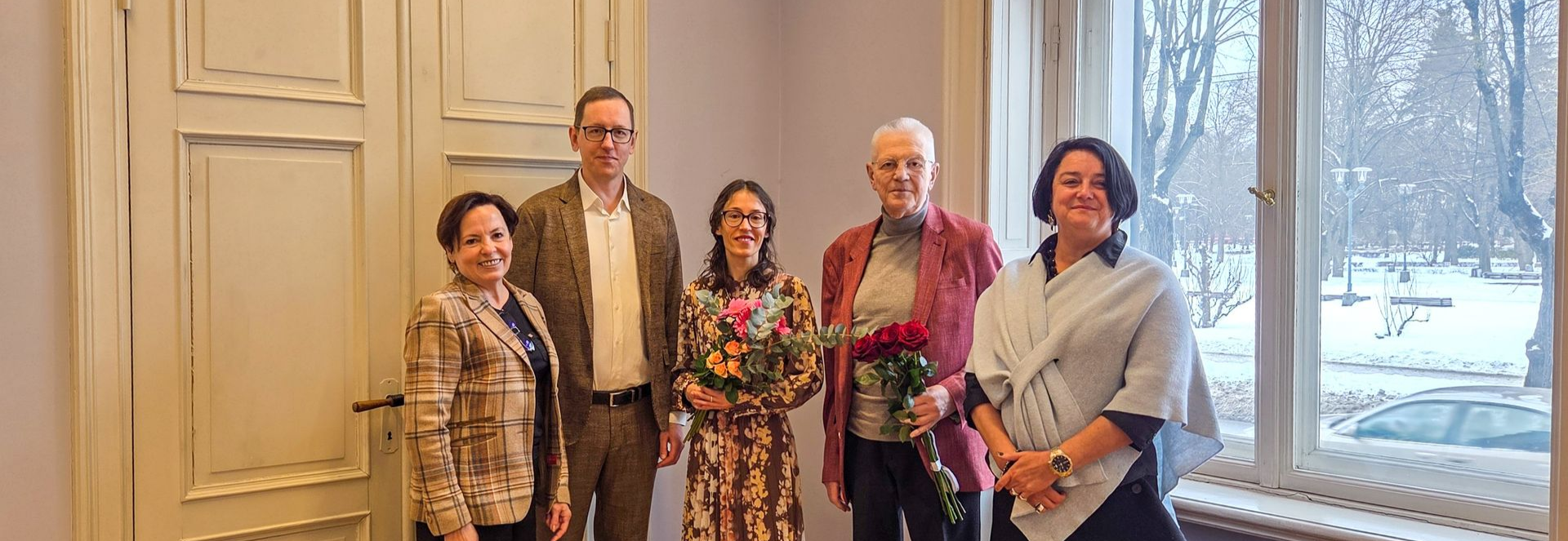
The Latvian Language Institute of the University of Latvia has published the monograph “Translation Studies. Past and Present, in the World and in Latvia” by Professor Emeritus Jānis Sīlis and Lecturer Aiga Bādere of the Faculty of Translation Studies at Ventspils University of Applied Sciences. The monograph is a significant resource for researchers in translation studies, university students, translation professionals, and other interested readers. For many years, Jānis Sīlis served not only as an associate professor, leading researcher, and professor at Ventspils University of Applied Sciences, but also as the Dean of the Faculty of Translation Studies. In the first three chapters of the monograph, he outlines the evolution of theoretical perspectives among translation scholars, discusses the understanding of translation theory and practice in the history of global translation studies, and examines both traditional and innovative research directions in Latvian translation studies over the past decade. In the fourth chapter, Aiga Bādere reviews publications on translation technology within Latvian translation studies and highlights the interdisciplinary nature of machine translation. In the fifth chapter, Jānis Sīlis expands the bibliographic corpus of publications by Latvian translation scholars initiated in his previous monograph. The monograph was prepared with the support of the National Research Programme “Latvian Studies for the Development of a Latvian and European Society”, project “Diversity of the Latvian Language in Time and Space” (VPP-LETONIKA-2021/4-0003). It is available in electronic format free of charge on the website of the Latvian Language Institute: https://lavi.lu.lv/2025-2/ .

Project news