An astronomer studies the onset of star birth
Astronomers may have found a new way to uncover the hidden history of star formation by studying something surprisingly simple: cosmic ice. In a new study published in the journal Astronomy & Astrophysics, Ventspils International Radio Astronomy Centre leading researcher Juris Kalvāns investigated how dense, dark central regions inside interstellar clouds, condense before they eventually give rise to new stars. The research examined the chemical fingerprints preserved in ice coatings on interstellar dust grains.
The study computationally tested five different scenarios for how a cloud core's density might increase over time, including gradual growth, rapid compression, and gravitational collapse. By comparing simulations with radio astronomical observations of interstellar ices such as water, the research determined which formation histories most closely match real cosmic clouds. The results suggest that the most likely path is neither an undisturbed gravitational collapse nor a sudden shock-driven compression, but a relatively smooth evolution lasting about two million years, featuring around one million years of active contraction. It may seem long but remember that the Solar System is 4.56 billion years old, and its formation over several million years actually was a rather rapid event.
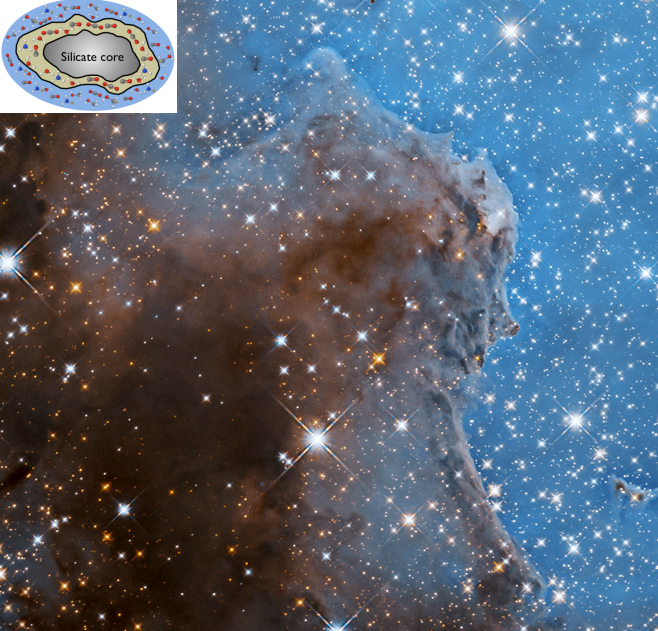
Dark interstellar clouds contain icy dust grains. Their cores are solid, made of rock or carbon, while the thin ice mantle consists of frozen water, carbon monoxide, carbon dioxide, methane (natural gas), ammonia, methanol (wood spirit), and other molecules also familiar on Earth.
One of the study's key findings is that ice chemistry acts as a natural archive of a cloud's past. As a cosmic cloud slowly becomes denser and darker, ice accumulates on dust grains and its composition records the physical conditions encountered along the way. The simulation results indicate that the formation of the central dense regions is shaped by external influences and galactic-arm-scale cloud evolution rather than gravity alone. By comparing observed ice compositions with simulated ones, researchers may be able to determine how individual cloud cores evolved. The work helps understanding the chain of events that transforms diffuse interstellar matter into the dense cradles of new suns. These starbirth regions are among the prime targets for radio astronomical observations by individual telescopes (molecule detections) and interferometric networks, such as JIVE in Europe (cloud structure measurements).
Such research not only helps us better understand the processes involved in star formation, but also strengthens scientific capacity in fields important to the advancement of modern astronomy. Working with complex radio astronomical data contributes to developing new knowledge and skills in radio astronomy, signal and data processing, electronics, and information technologies, while also opening opportunities for wider use of machine learning and artificial intelligence in research. At the same time, it supports the development of new research methods and technological solutions that can also benefit other fields of science.
The publication is available here: https://www.aanda.org/articles/aa/full_html/2026/09/aa53962-25/aa53962-25.html
This information has been prepared within the framework of the project “Ventspils University of Applied Sciences` International Cooperation and Innovation for the Development of Latvia’s Smart Specialisation” (Project No. 1.1.1.5/3/25/I/012).
Share on other platforms
Other news