Jupiter’s radio emission as a natural space weather indicator
The decametric radio emission of Jupiter (DAM) is one of the most powerful and structurally complex radio sources in the Solar System. Jupiter’s signals (an example is shown in Figure 1) and their fine spectral structure constitute a unique natural laboratory for plasma astrophysics. The Io–Jupiter electrodynamic circuit: the Jovian satellite Io, moving through the planet’s powerful magnetic field, acts as a giant unipolar inductor. This generates an enormous potential difference and drives currents of millions of amperes flowing along the magnetic field lines (within the so-called Io flux tube).
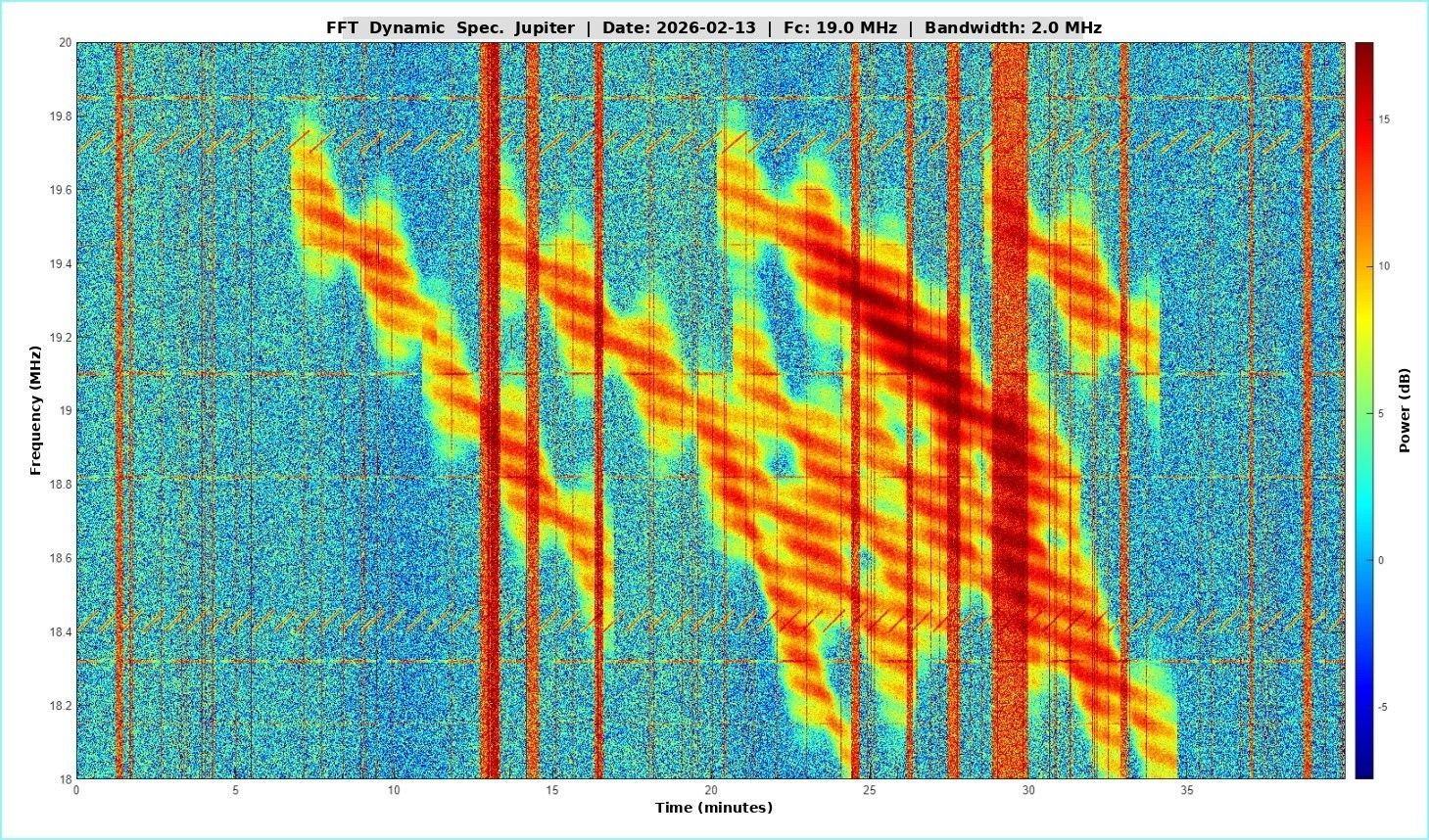
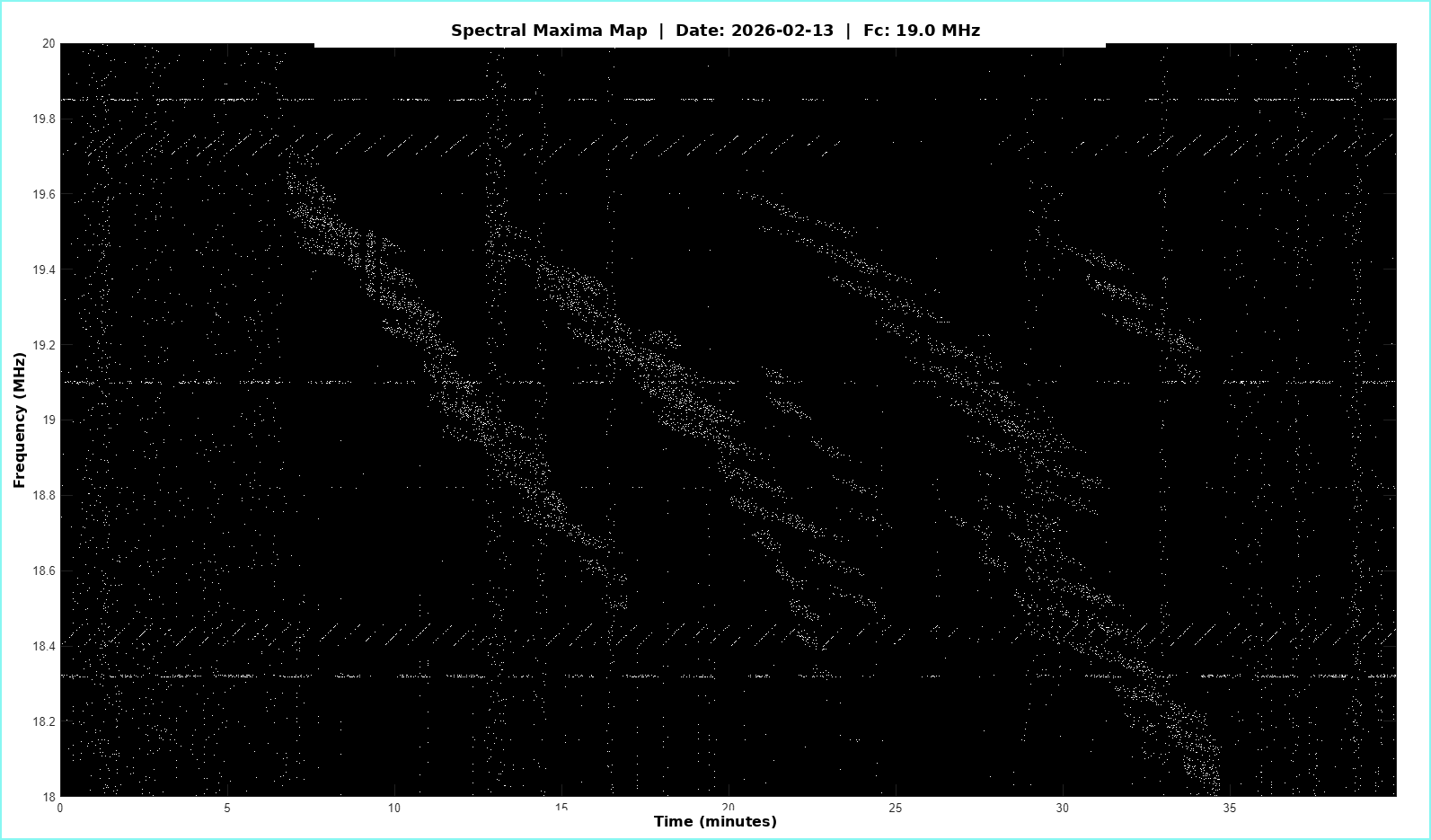
Example of an ionospheric zebra-like structure in the radio emission of Jupiter, recorded on 13.02.2026 with the decametric radio telescope «URAN-4» (village of Mayaki, Ukraine) (Institute of Radio Astronomy of the NAS of Ukraine (IRA NASU)) at a frequency of 19 MHz, against a background of radio-frequency interference (vertical and horizontal elongated stripes). The upper panel shows the dynamic spectrum, with a narrow bandwidth of 2 MHz, 2048 frequency channels, 70% window overlap, and a Dolph–Chebyshev spectral window. The lower panel is the map of dynamic-spectrum maxima, displaying the local maxima of the zebra-structure.
Electrons are accelerated along these field lines towards the poles of Jupiter. Upon entering the region of converging magnetic field, they are reflected back (the magnetic-mirror effect). This process produces a specific electron velocity distribution. Such a non-equilibrium plasma becomes unstable and begins to operate as a natural maser, coherently emitting radio waves at frequencies very close to the local electron cyclotron frequency. However, Earth’s ionosphere strongly modifies the received Jovian signal, and Faraday fringes are often produced. When a powerful, originally linearly polarised signal from Jupiter propagates through the plasma of Earth’s ionosphere, its plane of polarisation undergoes rotation. Since the rotation angle depends on frequency, at certain frequencies the wave arrives at the linear antenna of the telescope (for instance, URAN-4) aligned with the dipole axis (yielding a bright stripe), while at adjacent frequencies it arrives orthogonally (yielding a dropout, i.e. a dark stripe). Earth’s ionosphere itself thus “slices” Jupiter’s continuous spectrum into such broad diagonal bands. Analogous measurements are also being carried out with the radio telescope LOFAR LV614 in Latvia.
Jupiter acts as a giant natural detector of space weather, whose decametric radio emission responds to fluctuations of the solar wind within the orbital frame of the satellite Io. Analysis of the structure and dynamics of powerful decametric radio storms (DAM) makes it possible to remotely estimate the parameters of the interplanetary plasma, which is permeated by solar-wind density waves and by plasma clumps from coronal mass ejections.
The above-mentioned activities were carried out within the framework of the research application “Studies of space weather conditions during the 25th solar cycle observed along the Struve Geodetic Arc”, No. 1.1.1.9/LZP/1/24/048. The application is implemented within Project No. 1.1.1.9/1/24/I/001, co-financed by the European Regional Development Fund.
Share on other platforms
Other news