Magnetic disturbances in September 2026

October 13, 2026

Magnetic disturbance of 23–24 September 2026: Vernadsky (Ukrainian Antarctic station on Galindez Island, Argentine Islands archipelago, near the Antarctic Peninsula) and Nurmijärvi (Finland).


Today, the trend towards “network” science in space weather research reflects a fundamental shift from isolated local measurements to global, large-scale monitoring. Synchronously combining standardized datasets from many distributed stations makes it possible to build accurate dynamic models of the magnetosphere and ionosphere and to capture the integrated response of the Earth, composed of many local and regional responses to solar disturbances. One such “geomagnetic network” is INTERMAGNET, a global network of magnetic observatories that collects high-precision, standardized data on the Earth’s magnetic field. The network operates as a voluntary international consortium of scientific institutes and works closely with the International Association of Geomagnetism and Aeronomy (IAGA); all INTERMAGNET observatories are affiliated with IAGA. Thanks to the considerable efforts of the National Antarctic Scientific Center of Ukraine and the S. I. Subbotin Institute of Geophysics of the National Academy of Sciences of Ukraine, the geomagnetic observatory at the Antarctic station Akademik Vernadsky has been a member of INTERMAGNET since 2004 (code AIA), and anyone, including Latvian scientists, can take part in studying disturbances of the Earth’s magnetic field in the Antarctic region using its freely available data.


As an example, let us consider an interesting event, the geomagnetic disturbance of 23–24 September 2026, by comparing the regional geomagnetic response recorded by the vector magnetometers at Akademik Vernadsky (Antarctica) and Nurmijärvi (Finland).


The event

A fast solar wind stream reached the Earth from a coronal hole on the Sun, a region where the magnetic field is open to interplanetary space. It was preceded by a compression region: the fast plasma caught up with the slower wind ahead of it and compressed it together with its magnetic field. The disturbance turned out to be weak: the Kp index reached 4.33 out of 9, whereas a storm on the NOAA scale starts at Kp 5.

Time (UT) In interplanetary space On Earth
23 Sep, 00–17 Slow wind, weak field Quiet: Kp ≤ 1, only the usual daily variation
23 Sep, 17–24 Compression region arrives; the interplanetary field points north Dst rises to +32 nT; pulsations switch on at both stations; Kp < 2
24 Sep, 00–24 The field turns south and stays south; wind speed increases Dst falls from +29 to −33 nT (minimum at 17–18 UT); Kp up to 4.33 at 09–12 UT

What the stations saw

Akademik Vernadsky (Antarctica, AIA) and Nurmijärvi (Finland, NUR) lie in opposite hemispheres, at magnetic latitudes of −52° and +58°. The field lines through them extend into space to 2.6 and 3.4 Earth radii, and the stations are 6 hours apart in magnetic local time.

  • Most of the range is the ordinary daily variation. During the day the Sun heats the upper atmosphere, winds in the ionosphere drive electric currents, and the field changes by 40–50 nT even on a quiet day. So the 83–93 nT range over the two days is mostly this variation, not the storm.
  • Nurmijärvi sees the electrojets. These are strong currents in the ionosphere at an altitude of about 100–120 km along the auroral oval. On the morning of 24 September a westward current flowed over the station (the northward field component decreased). In the evening an eastward current flowed north of the station (vertical component +70 nT), and at night, in the same place, a westward current again (−75 nT). When a current flows north of the station, the vertical component increases for an eastward current and decreases for a westward one.
  • Vernadsky is farther from the oval. There, bays of about ±45 nT are seen in the eastward component at 07–11 UT. They were caused by currents along the field lines that link the magnetosphere with the ionosphere during a substorm (09–12 UT).
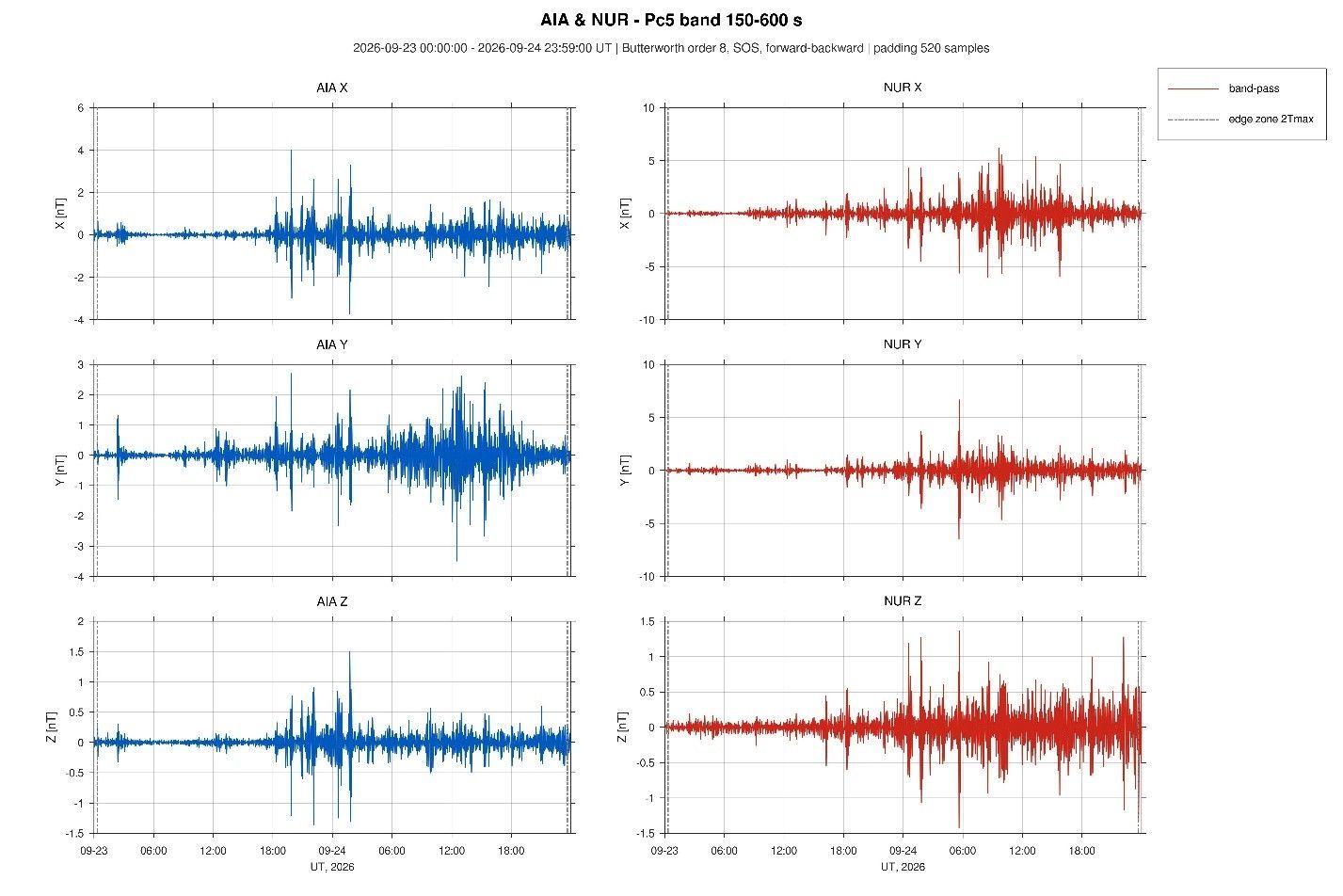
Fig. 1. Example of geomagnetic pulsations on 23–24 September 2026 in the 150–600 s period band (Pc5) at the Antarctic station Akademik Vernadsky and the Finnish station Nurmijärvi.

Magnetic pulsations

Pulsations are slow oscillations of the magnetic field. The analysis uses the period bands 2.5–10 min (Pc5) and 10–30 min (Pc6). The typical amplitude is 0.4–1.7 nT, reaching 5–8 nT at peaks: no more than ~0.02% of the Earth’s field (37,000–53,000 nT).

  • They started before the storm. Pulsations appeared simultaneously at both stations at 17–19 UT on 23 September, while the interplanetary field was still northward. This means they were excited by the dense wind itself: its pressure fluctuations push the boundary of the magnetosphere, and on its flanks the fast flow excites waves, like wind over water.
  • 1.4–2 times stronger at Nurmijärvi. The station is closer to the auroral oval and to the high-latitude sources of the oscillations.
  • A common “note” with a period of 13–14 min. An interesting feature revealed by spectral and cross-spectral analysis. Both stations show the same spectral peak at 1.21–1.27 mHz (13.8–13.1 min), and it is coherent between the stations. For stations in opposite hemispheres and 6 hours apart, this means an oscillation of the whole magnetosphere or a rhythm set by the solar wind. The natural oscillations of the local field lines here are much faster, with periods of typically 10–150 s.
  • But the common part is small. At these frequencies, only 7–25% of the oscillation power is common to the two stations. The rest comes from local processes: ionospheric currents and impulsive bursts during substorms.
  • Mirror symmetry. Measured from the magnetic meridian, the major axis of the oscillations is rotated by +32° at Vernadsky and by −32° at Nurmijärvi, and the sense of rotation is opposite. The patterns are mirror images about the meridian: the north–south component is the same, and the east–west component is opposite. This is exactly how oscillations that are symmetric about the magnetic equator behave.
  • Seasonal factor. Near the September equinox (23 September in 2026), geomagnetic activity is statistically higher when the interplanetary magnetic field points away from the Sun, i.e. has positive polarity (the Russell–McPherron effect). The positive-polarity stream with a persistently southward Bz after 00 UT on 24 September is consistent with this.
  • Over the observation interval of 23–24 September 2026, AIA was most active in the late evening and before dawn, and NUR in the afternoon and evening (horizontal components, local time).
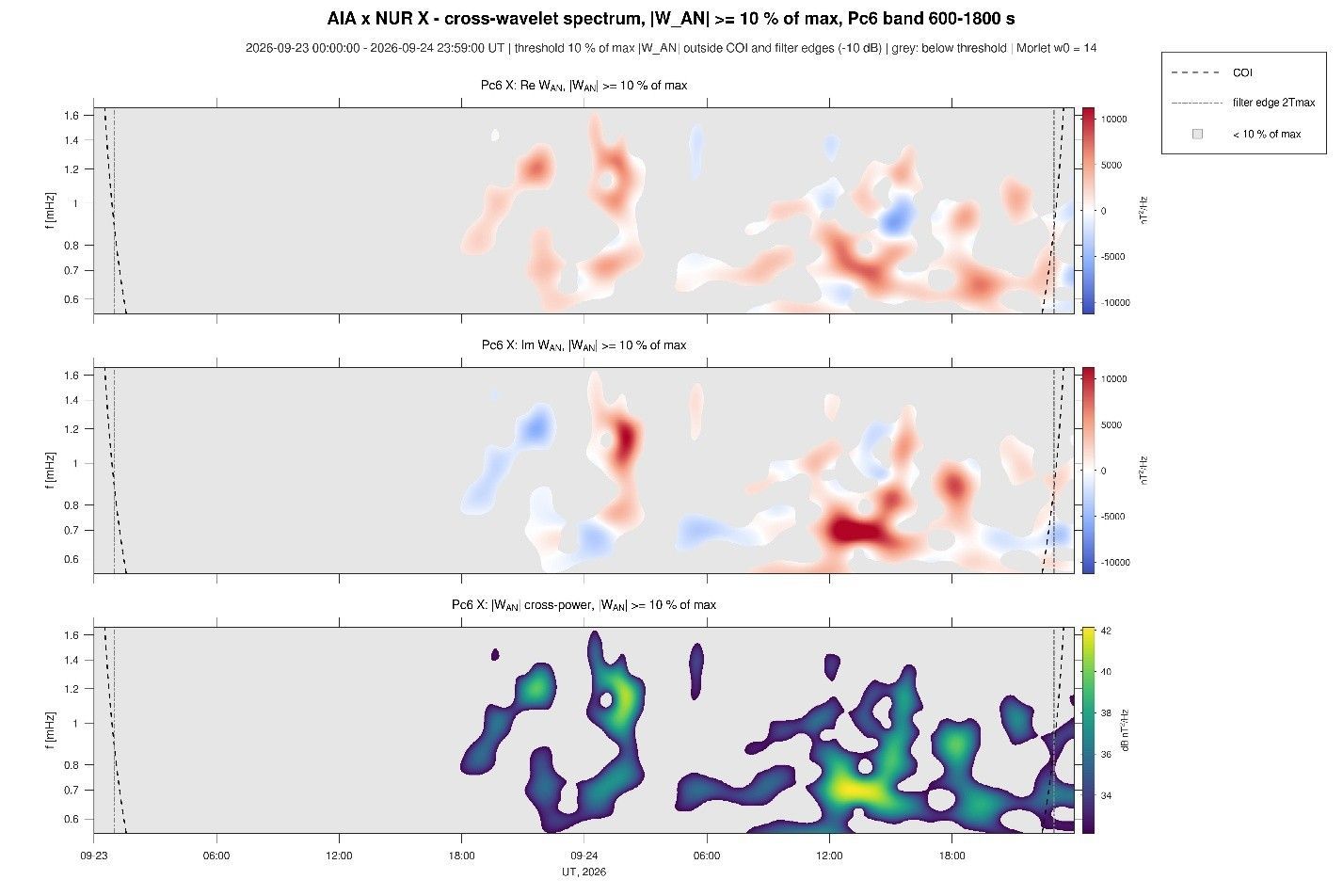
Fig. 2. Example of the cross-wavelet spectrum between the geomagnetic stations AIA (Antarctica) and NUR (Finland) – the geomagnetic X component is compared in the Pc6 band (600–1800 s); only areas with at least 10% of the maximum cross-power are shown. Top panel – real (Re) part, middle panel – imaginary (Im) part of the cross-spectrum, bottom panel – cross-spectral power. Re shows how much the two stations oscillate in step: positive means that the field at both stations deviates in the same direction at the same time, negative means in opposite directions. Im shows which station leads the other: positive means that the oscillation arrives at Nurmijärvi first, negative means at Vernadsky first.

The pulsations were excited by the solar wind itself: they appeared under northward IMF, at the peak of the magnetospheric compression, before the storm began. The dominant Pc5 periods differ between the stations: about 6 min at Vernadsky and about 5.3 min at Nurmijärvi. This means these oscillations are local. Only the line at about 13 min is common, and it points to a global oscillation of the magnetosphere or a rhythm of the solar wind. The broadband impulsive spectra indicate a response to pressure bursts and substorms rather than to steady resonances (in the period bands of the quasi-periodic Pc5 and Pc6 pulsations, irregular Pi3-type pulsations dominate, with only a weak quasi-periodic component at about 13 min). The horizontal components are mostly in phase at stations about 15,800 km apart. This is a sign of a global magnetospheric source. The polarization is mirror-symmetric, which indicates that the processes are symmetric about the magnetic equator. Nurmijärvi is more active because it is closer to the auroral oval.


Author: Artem Sukharev, PostDoc researcher

Share on other platforms

Other news
By Rota Žagare • October 12, 2026
Andris Vaivads, Rector of Ventspils University of Applied Sciences, has been elected as a new foreign member of the Royal Swedish Academy of Sciences' Class for Astronomy and Space Science. Andris Vaivads studies what is commonly known as the magnetosphere around the Earth, other planets and the SunClass for astronomy and space science. He performs his research as a professor in Experimental Space Physics at KTH Royal Institute of Technology in Stockholm. Earlier, he spent 20 years as a researcher at the Swedish Institute of Space Physics in Uppsala. He studies the magnetosphere around Earth, other planets, and the Sun. Much of space is filled with plasma, a gas consisting of electrically charged particles that are influenced, among other things, by magnetic fields. When magnetic fields pointing in different directions reconnect – a process known as magnetic reconnection – large amounts of magnetic energy can rapidly be converted into other forms of energy, including kinetic energy. Andris Vaivads’s research focuses on these processes, where large amounts of energy are converted within small regions of space. Plasma processes can, among other things, produce the Northern lights (Auroras), affect satellites, and heat plasma to tens and hundreds of millions of degrees. The research group at KTH, in which Andris Vaivads spends 20 per cent of his working time, develops instruments to measure electric fields on satellites. The group also designs small measurement probes that can be launched from Esrange Space Centre in Kiruna on rockets. More recently, Andris Vaivads has also studied processes in the solar wind, a kind of plasma wind that plays a major role in space weather. This research uses observations from spacecraft launched by ESA (Solar Orbiter) in Europe and NASA (Parker Solar Probe) in the US. Members of the Royal Swedish Academy of Sciences serve on committees and participate in classes that initiate investigations, respond to consultations, and organise conferences and seminars. Based on the information published on the official website of the Royal Swedish Academy of Sciences.
By Rota Žagare • September 18, 2026
On 24 September, Ventspils University of Applied Sciences will host the international scientific seminar “Massive Star Formation – Latest Research and Developments”, organised by the Ventspils International Radio Astronomy Centre (VIRAC). The seminar will bring together researchers and those interested in research with visiting scientists from the United States. The seminar will feature scientist Dr Todd R. Hunter and Lead Astronomer Dr Crystal L. Brogan from the U.S. National Radio Astronomy Observatory (NRAO). The guests will present current research in radio astronomy, state-of-the-art observational infrastructure, and the opportunities it provides for studying the Universe and the processes of star formation. Dr Todd R. Hunter will give a presentation entitled “Exploring the Universe at Centimeter Wavelengths: The Next Generation Very Large Array”, while Dr Crystal L. Brogan will present “Searching for Our Cosmic Origins Using the Atacama Large Millimeter/submillimeter Array”. The seminar will provide researchers with an opportunity to discuss the latest research findings and methods with internationally recognised experts in radio astronomy, as well as to explore opportunities for future scientific collaboration. Such international knowledge-exchange activities strengthen the research capacity of Ventspils University of Applied Sciences and promote the involvement of Latvian researchers in the international radio astronomy research community. This information has been prepared within the framework of the project “Ventspils University of Applied Sciences` International Cooperation and Innovation for the Development of Latvia’s Smart Specialisation” (Project No. 1.1.1.5/3/25/I/012). 
By Rota Žagare • September 18, 2026
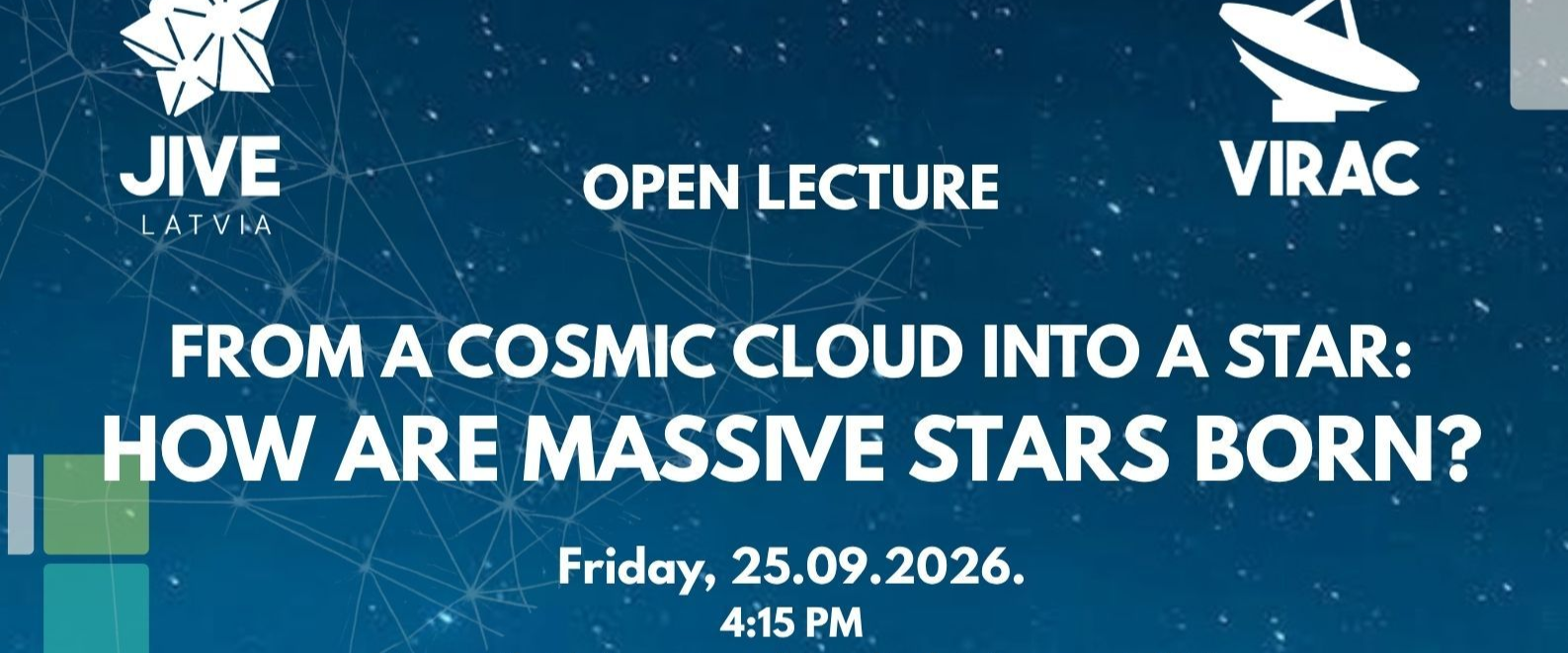
On Friday, 25 September, at 16:15, Ventspils University of Applied Sciences invites everyone interested to attend the popular science open lecture “From Cosmic Cloud to Star: How Massive Stars Are Born”. The lecture will offer an engaging and accessible introduction to how massive stars are born, how astronomers are able to observe their formation, and what these studies can reveal about the origins and evolution of our Universe. The lecture will be delivered by guests from the U.S. National Radio Astronomy Observatory (NRAO) – scientist Dr Todd R. Hunter and Lead Astronomer Dr Crystal L. Brogan. Both researchers use modern radio astronomy techniques to study star formation and processes taking place throughout the Universe. The lecture is particularly suitable for astronomy enthusiasts as well as anyone interested in space and the methods scientists use to explore the Universe. No prior knowledge of astronomy is required. The lecture will be held in English, and participation is free of charge. The open lecture will complement the European Researchers’ Night programme in Ventspils. After the lecture, participants will have the opportunity to continue exploring science at the VIZIUM Science Centre, where European Researchers’ Night activities will take place. The lecture is organized with the financial support of the Baltic-American Freedom Foundation (BAFF), in cooperation with the Ventspils International Radio Astronomy Centre (VIRAC).
By Rota Žagare • September 11, 2026
As the availability of artificial intelligence (AI) tools continues to grow, so do their capabilities and the range of tasks they can perform, including increasingly complex and sophisticated ones. Consequently, AI is finding applications in ever narrower and more specialised fields. Scientific research in astronomy is no exception, including radio astronomy and related theoretical fields, which are among the areas of research pursued by scientists at the Ventspils International Radio Astronomy Centre (VSRC) of the Institute of Engineering at Ventspils University of Applied Sciences. AI is based on existing knowledge and cannot independently interpret newly generated scientific results. Nevertheless, AI-assisted data processing, generation of program code, partially repetitive data rows and other types of information, as well as the initial compilation and review of large volumes of information on a scientific topic or, for example, the operation of an existing program, can facilitate certain tasks when carried out under careful supervision and verification by a researcher. The results can, in turn, be checked using another version of an AI agent. However, these approaches do not necessarily reduce the overall amount of work or the time required to complete it. To make the most effective use of the opportunities offered by AI and to communicate this knowledge in an accessible way so that it can subsequently be learned and adopted by everyone involved in research, including members of the older generation of scientists, VSRC launched a series of seminars on the use of AI in science in autumn 2026. The series places particular emphasis on astrophysics and radio astronomy, including radio interferometric observations using the Irbene Radio Telescope (IRT) and the LOFAR network. The first seminar was led by VSRC scientific assistant Gints Jasmonts, who shared his knowledge and experience on 3 September. He provided an introduction to the world of AI and presented examples from his own work in computer science and astrophysics. The discussion focused primarily on large language models available through chat interfaces, search engines and programming environments. At their core, these AI systems operate by predicting the next word or token based on the preceding context. The seminar concluded with a discussion, which revealed that participants are already using AI in their everyday work. At the same time, it became clear that learning how to apply the diverse capabilities of AI specifically to research will require further learning. The next seminar will therefore have a more practical focus. This information has been prepared within the framework of the project “Ventspils University of Applied Sciences` International Cooperation and Innovation for the Development of Latvia’s Smart Specialisation ” (Project No. 1.1.1.5/3/25/I/012).
By Rota Žagare • August 31, 2026
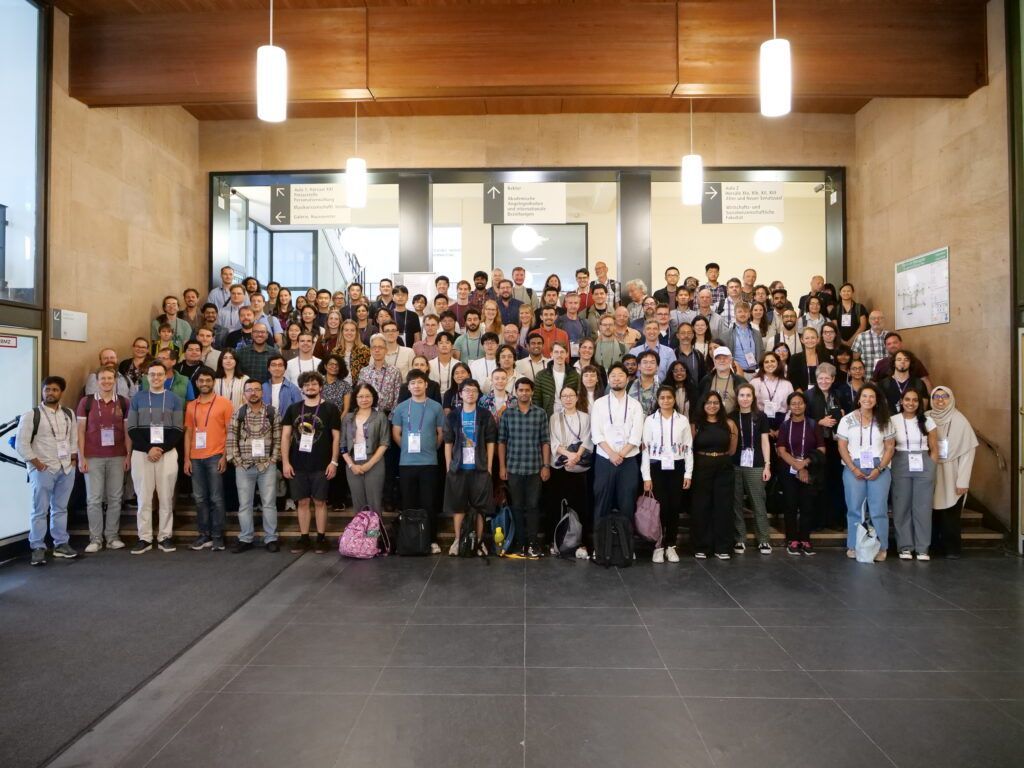
Dr. Artis Aberfelds, Senior Researcher at the Engineering Research Institute "Ventspils International Radio Astronomy Centre" (VIRAC) of Ventspils University of Applied Sciences, participated in the prestigious international symposium "SFB 1601: Cologne-Bonn Symposium on the habitats of massive stars across cosmic time" held at the University of Cologne, Germany. A scientific report on methanol maser activity around forming massive stars was presented during the event. Organized by the University of Cologne, the symposium brought together leading astrophysicists and radio astronomers from around the world to discuss the latest discoveries in star formation, the interstellar medium, and the physical processes governing the birth of stars. The research presented by Dr. Aberfelds was developed in close international collaboration with researchers A. Sanna and L. Moscadelli from the Italian National Institute for Astrophysics (INAF). Utilizing the Karl G. Jansky Very Large Array (VLA) in the USA – one of the world's most sensitive radio telescope arrays – the study analyzed the connection between 6.7 GHz methanol (CH3OH) maser emission, stellar radiation, and outflows from young massive stars. Key Findings and Conclusions: Discovery of 5 new maser sources: Observing 22 star-forming regions, 6.7 GHz methanol maser emission was detected in 13 objects, revealing 5 previously unknown maser sources. Precise indicator of stellar location: Over 90% of all detected maser spots are located in close proximity to the central star. Direct link with thermal free-free radio continuum emission: The study revealed a strong correlation between methanol maser luminosity and thermal radio emission, enabling astronomers to more accurately predict and identify weak radiation sources in the Universe in the future. Potential for next-generation radio telescopes: Calculations indicate that more than 30% of the methanol maser population currently remains undetected due to sensitivity limits of existing instruments. These sources will be unlocked by next-generation radio interferometers (such as the ngVLA and SKA). The research and conference participation were carried out within the framework of the Latvian Council of Science (LZP) Fundamental and Applied Research Project „Revealing the physical mechanism of mass ejection around young massive stars via CH3OH masers” (Project No. 1.1.1.9/LZP/1/24/044).
By Rota Žagare • August 23, 2026
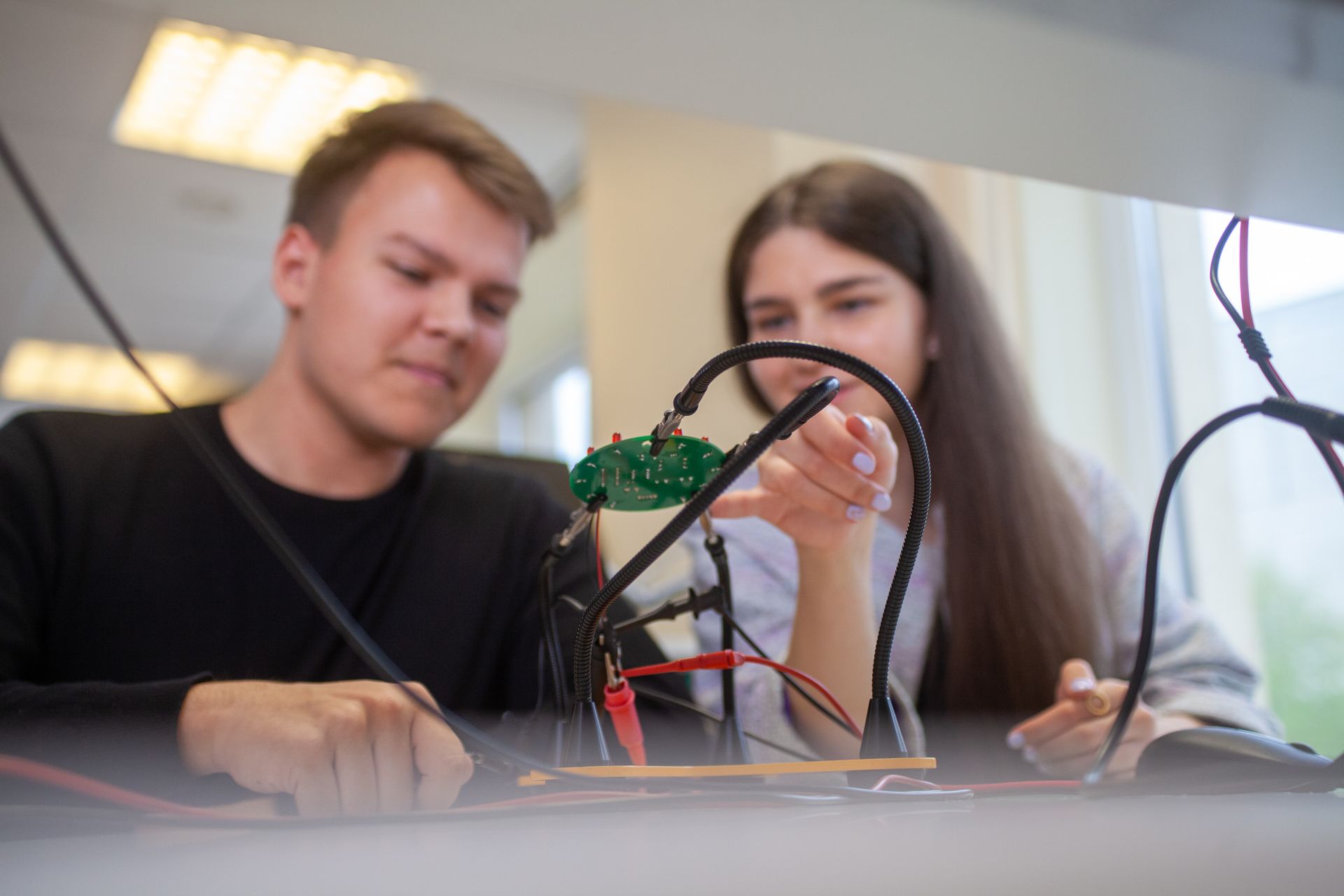
As the new academic year gets underway, students at Ventspils University of Applied Sciences (VUAS) can already benefit from a range of improvements implemented through the project “Modernisation of the Study Environment at Ventspils University of Applied Sciences”. The upgraded facilities include a newly equipped computer lab with modern computers and monitors, a renovated laboratory with new furniture designed for the needs of the study process, as well as upgraded physics laboratories with new experimental equipment and technology. Further improvements have been introduced in other classrooms, where modern interactive screens have been installed. These provide lecturers and students with greater opportunities to use digital learning materials during classes and make the learning process more interactive. The screens can be easily connected to both lecturers’ and students’ computers, allowing them to display presentations, coursework, projects and other study materials. A particular focus of the project has been the modernisation of the physics laboratories. Students can now work with new experimental laboratory equipment, enabling them to complement theoretical knowledge with practical experiments and hands-on experience with modern technologies. The newly installed laboratory furniture provides a more comfortable and functional workspace, while the layout of the laboratory has also been designed with accessibility in mind, ensuring that the environment is convenient for everyone. The modernised computer lab likewise creates new opportunities for students to complete practical assignments, develop programming skills, work on projects and use the software required for their studies. The modernisation of VUAS study environment, however, is still ongoing. Further improvements are planned as the project continues. The sound systems in two large auditoriums will be renewed, improving the technical facilities for lectures, presentations and other events. The physics laboratories will also be equipped with additional electronic measuring instruments, giving students even more opportunities to carry out practical work, experiments and measurements. The project will therefore continue to bring benefits to students, contributing not only to the modernisation of individual study rooms and equipment, but also to the gradual development of the university’s study environment as a whole. As part of the project, the infrastructure supporting the study programmes implemented by the Faculty of Information Technologies is being improved, with particular emphasis on the modernisation of laboratories, auditoriums, computer equipment and other facilities essential to the study process. T he project “Modernisation of the Study Environment at Ventspils University of Applied Sciences”, No. 4.2.1.8/2/25/I/007, is being implemented from 1 September 2025 to 31 August 2027. The total project budget is EUR 215,083.00, of which 85%, or EUR 182,820.55, is financed by the European Regional Development Fund, while 15%, or EUR 32,262.45, is financed from the state budget.
Other news