MarTe: Marine technology excellence hub for sustainable blue economy in Baltics

Project title: MarTe: Marine technology excellence hub for sustainable blue economy in Baltics
 

Project's No: 101186498


Project acronym: MarTe


Funded by: European Commission – Horizon Europe, HORIZON-WIDERA-2023-ACCESS-07-01. Nr. 101186498.


Project's partners: Sihtasutus Keskkonnainvesteeringute Keskus, Saare Development Centre, Tallinna Tehnikaülikool, Tartu Ulikool, Association Of Estonian Marine Industries, Mittetulundusühing Saarte Koostöökogu, Kurzemes Planosanas Regions, Latvijas Hidroekologijas Instituts, Pasaules Dabas Fonds, Biedriba Baltijas Krasti, Free Port Of Ventspils Authority, Latvijas Investiciju Un Attistibas agentura.

Project's duration: January 1, 2025 – December 31, 2028


Project's total budget: Total project budget 4799525,00 EUR EUR, VUAS budget - 367850,00 EUR.


Project's homepage:  www.marinetechub.eu


Project's social media:


Project's summary:

The MarTe project aims to facilitate sustainable blue growth in the Baltic region by establishing Estonian and Latvian marine and maritime innovation ecosystem Excellence Hub. This will be achieved through the collaboration of diverse stakeholders including academic institutions (TalTech, University of Tartu), government agencies (Environmental Investment Centre, Kurzeme Planning Region), industries (Association of Estonian Marine Industries, Port of Ventspils), and civil society (WWF Latvia, Saarte Koostöökogu).


MarTe is dedicated to addressing environmental changes and enhancing regional economic development. The project will establish cross-border excellence hub to catalyse innovation, enhance the marine value chain, and encourage the adoption of new technologies. Project objectives include collaborative R&D in sustainable marine resource use, ecosystem empowerment, and policy influence. By leveraging quadruple-helix collaborations, MarTe aims to advance marine and maritime technologies, reinforce stakeholder linkages, improve ecosystem capacity building, close knowledge gaps, support SMEs and startups, and elevate the visibility of the Estonian-Latvian blue economy innovation ecosystems. The strategic framework focuses on areas like offshore energy, smart ports, and marine ecosystem protection, in alignment with EU Green Deal and regional smart specialization strategies.


Through a comprehensive approach encompassing stakeholder engagement, R&I strategy development, and capacity building,

MarTe strives for a significant impact on the sustainable blue economy in Baltics.


Latvia is represented in the project by the Investment and Development Agency of Latvia (LIAA), Kurzeme Planning Region, Latvian Institute of Hydroecology, Worldwide Fund for Nature, Baltic Coasts, Ventspils Freeport and Ventspils University of Applied Sciences, while the Estonian Environmental Investment Centre is the lead partner and coordinator of the project.


Project Objectives:

  • Strengthening Research and Innovation (R&I) Ecosystems: The project seeks to build robust and innovative institutions that support R&I in marine and maritime sectors, contributing to the sustainable growth of the blue economy. A key focus is improving research capabilities, retaining talent, and enhancing collaboration between Estonia and Latvia.
  • Quadruple Helix Collaboration: MarTe emphasizes collaboration across academia, government, industry, and civil society. This approach aims to improve coordination along the maritime value chain and ensure sustainable linkages beyond the project's duration. The ultimate goal is the development and validation of R&I strategies, action plans, and investment plans.
  • Conducting Joint Research and Knowledge Exchange: The project will perform joint research to fill knowledge gaps in marine technology and implement learning and skills development initiatives. An Excellence Hub will foster collaboration among scientists, industry professionals, and local communities. Four R&I projects on emerging marine technologies will address specific challenges within the ecosystem.
  • Increasing Innovation Visibility: MarTe aims to raise the visibility of the Estonian-Latvian innovation ecosystem by organizing networking events, knowledge exchange sessions, and training programs. These efforts are expected to boost cross-sectoral collaboration, improve research capacities, and foster sustainable innovation.


Expected Results:

  • Long-term R&I Strategy: The project will develop and implement a joint R&I strategy, supported by action and investment plans to guide future research and innovation in the marine sector.
  • Scientific and Economic Impact: MarTe expects to produce at least three peer-reviewed publications and initiate four cross-sectoral R&I projects focused on developing new technologies for sustainable use of marine resources. These efforts will enhance Estonia and Latvia's competitiveness in the blue economy sector.
  • Support for Startups and SMEs: The project will provide financial grants and mentoring to at least six start-ups and SMEs, enabling them to bring innovative solutions to market. This initiative is designed to overcome barriers to commercialization and support technology transfer.
  • Policy Influence: MarTe will contribute to shaping regional and international policies by providing evidence-based recommendations for sustainable marine development. It will align its outputs with existing European and global frameworks, such as the EU Green Deal.


This project aims for significant societal, economic, and scientific impacts, fostering sustainable innovation in the marine and maritime sectors of Estonia and Latvia.


Contacts:

Project coordinator  

Vladislavs Bezrukovs, vladislavsb@venta.lv. Phone: +37127134283.


Project administrative manager:

Baiba Reimane, baiba.reimane@venta.lv.


Project News
By Rota Rulle February 13, 2026
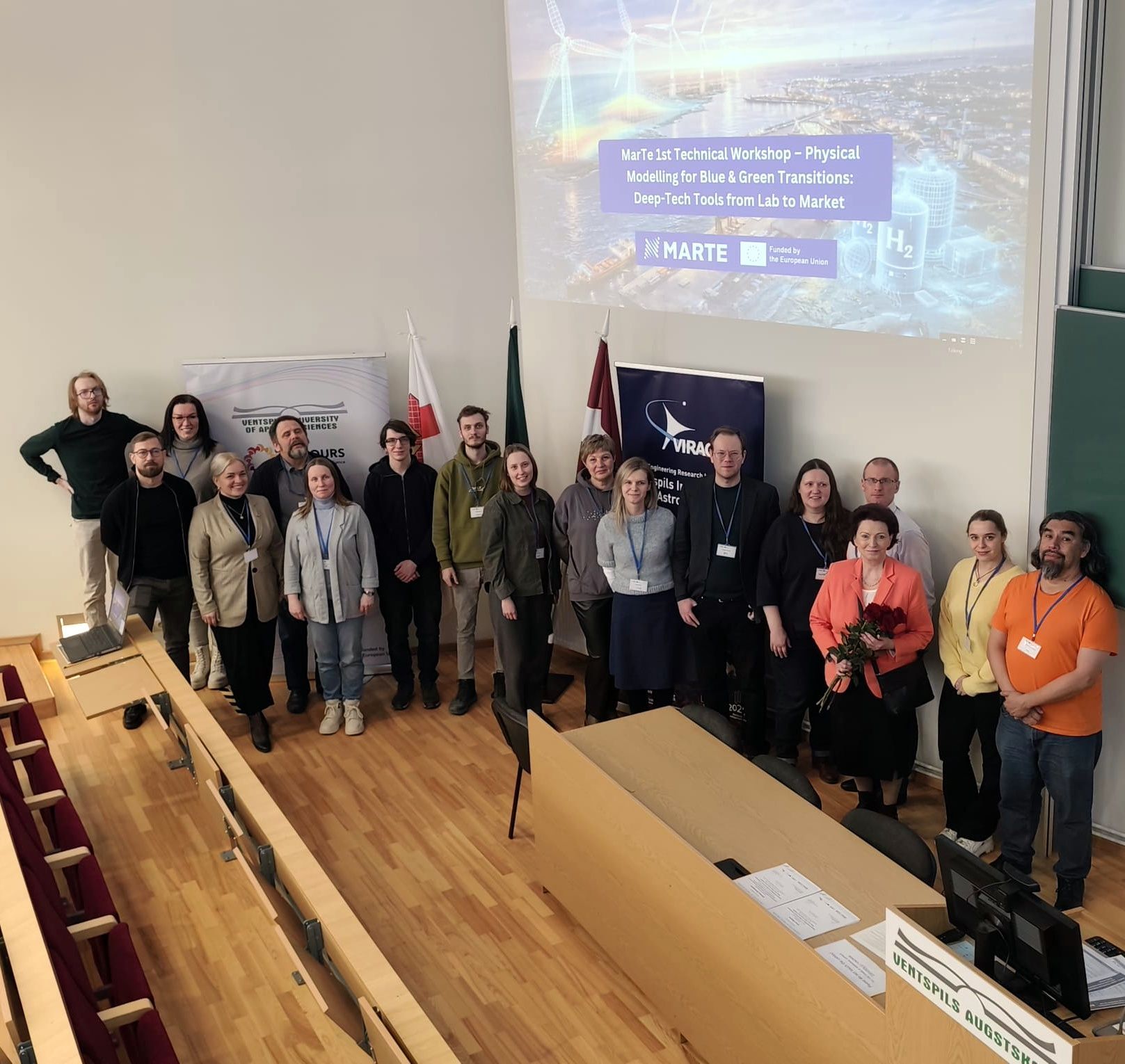
Offshore wind energy, green hydrogen production, sustainable maritime transport, smart port infrastructure, and marine biotechnology are increasingly recognised as key pillars of the sustainable blue economy in the Baltic Sea region, shaping its long-term environmental resilience, energy independence, and economic transformation. At the first technical workshop of the project Marine Technology Excellence Hub for Sustainable Blue Economy in the Baltics (MarTe) , held at Ventspils University of Applied Sciences (VUAS), researchers demonstrated how such ambitions depend on advanced physical modelling and simulation tools that bridge research and industrial implementation. The workshop, titled “ Physical Modelling for Blue and Green Transitions: Deep-Tech Tools from Lab to Market ”, brought together experts from VUAS, Riga Technical University, the University of Latvia, the UL Institute of Solid State Physics, Latvia University of Life Sciences and Technologies, Tallinn University, and the University of Tartu. Physical Modelling as a Development Engine A central theme of the event was the role of numerical simulation in accelerating technological development. Using tools such as SOLIDWORKS, COMSOL Multiphysics, OpenFOAM, and other advanced platforms, engineers can analyse structural behaviour, fluid dynamics, heat transfer, electromagnetics, and multiphysics interactions before building physical prototypes. “MarTe connects academic staff in Latvia and Estonia with industry, public administration and funding organisations to jointly develop innovation related to the Baltic Sea, coastal regions and ports,” explained VUAS researcher Vladislavs Bezrukovs. “We focus on science-intensive deep-tech solutions that support the green transition and digitalisation, including offshore renewable energy systems, green hydrogen technologies, maritime decarbonisation, smart port infrastructure, environmental monitoring, and bio- and hydro-technologies tailored for the Baltic Sea region.” Open-Source and Commercial Tools in Practice Sabīne Upnere (Riga Technical University) demonstrated applications of the open-source computational fluid dynamics toolkit OpenFOAM, highlighting its importance for small and medium enterprises due to the absence of costly licences. She showed how complex wind and water flow phenomena can be modelled in maritime contexts, including structural interaction and thermal processes. Normunds Jēkabsons (University of Latvia) shared long-term experience in modelling wind turbines, vibration, heat transfer, and industrial flow systems, emphasising the strategic value of open-source tools for research flexibility and innovation capacity building. From the commercial software perspective, Martin Johansson and Alex K. Aaskilde (PLM Group Sverige AB) introduced the newest features in SOLIDWORKS, including AI-assisted design functionalities that automate optimisation and reduce development time. They also presented support programmes offering free licences for early-stage start-ups, lowering barriers to innovation. Modris Dobelis (Riga Technical University) demonstrated how SOLIDWORKS is integrated into engineering education and certification pathways, giving participants hands-on modelling opportunities and illustrating the direct link between academic training and industrial competence. Marina Konuhova (Institute of Solid State Physics, University of Latvia) demonstrated how multiphysics simulation in COMSOL enables the modelling of strongly coupled physical processes in liquid–hydrogen systems, including thermodynamic, fluid dynamic, and mechanical interactions relevant to renewable energy and industrial hydrogen applications. Her presentation illustrated how advanced numerical modelling supports optimisation of compression processes, improves system safety and efficiency, and reduces development risks at early design stages. Vladislavs Bezrukovs (VUAS) showcased the application of electromagnetic (EM) simulations in EMWorks for analysing field distribution, induced currents, and performance constraints in linear generator systems. The presentation emphasised how accurate modelling of complex geometries and realistic boundary conditions is essential for predicting electromagnetic behaviour, optimising generator efficiency, and ensuring reliable operation in demanding engineering environments. Modelling for Safety, Environment and Green Transition Kristjan Tabri (Tallinn University of Technology) presented a comprehensive numerical reconstruction of the MS Estonia ferry disaster. His work illustrated how structural modelling and load simulations can deepen understanding of ship failures and contribute to maritime safety standards. Environmental forecasting was addressed by Uldis Bethers and Tija Sīle (University of Latvia). They presented modelling systems that predict wind, wave, and hydrodynamic conditions without direct measurement, supporting port operations and coastal risk management. From the industry perspective, Laura Apoga (LVR Flote Ltd) delivered an overview of maritime innovation within Latvia’s fleet modernisation efforts. She presented examples of hybrid vessel implementation, operational optimisation, and collaborative models between public institutions and industry partners. The talk highlighted practical pathways for introducing greener propulsion systems and improving coastal support services. Andrejs Zvaigzne (Riga Technical University) showcased the development of zero-emission hydrogen fuel cell fishing vessels, discussing technical integration and regulatory challenges for decarbonising Baltic maritime transport. Andrejs Krauklis (Latvia University of Life Sciences and Technologies) discussed modelling of hydrothermal ageing and polymer degradation, critical for assessing long-term material reliability and environmental pollution risks. Aleksejs Zolotarjovs (Institute of Solid State Physics, University of Latvia) presented the Spectromarine case study – a successful example of bringing laboratory-developed water monitoring technologies to market through strategic niche positioning. From Digital Design to Sustainable Blue Economy Across all presentations, one message was clear: physical modelling is not an auxiliary tool but a core driver of innovation. By combining structural simulations, hydrodynamics, energy systems modelling, and environmental forecasting, researchers can move efficiently from theoretical concepts to industrial prototypes. The workshop, which was attended by more than 50 participants both in person and remotely, demonstrated how simulation technologies underpin the transition to a sustainable blue economy in the Baltic region – enabling safer ships, greener propulsion systems, optimised port operations, and advanced marine materials. Recorded presentations from the MarTe technical workshop are available on YouTube allowing a broader audience to access the knowledge shared during the event. MarTe continues to strengthen collaboration between Latvia and Estonia, aligning academic expertise with industry needs and supporting the development of deep-tech solutions for the Baltic Sea region. MarTe project: Marine technology excellence hub for sustainable blue economy in Baltics (European Commission – Horizon Europe, HORIZON-WIDERA-2023-ACCESS-07-01. Nr. 101186498.
By Rota Rulle February 2, 2026
MarTe 1st Technical Workshop “Physical Modelling for Blue & Green Transitions: Deep-Tech Tools from Lab to Market” Date: 4–5 February 2026 Venue & Format: Hybrid On-site: Ventspils University of Applied Sciences (Ventspils Augstskola) 101A Inženieru Street, Ventspils, LV-3601, Latvia Online: Zoom (with live YouTube translation) Language: English Registration: HERE About the Workshop The MarTe 1st Technical Workshop brings together researchers, industry representatives, startups, and students to explore how modern physical modelling and simulation tools can accelerate innovation in the blue and green economy . Aligned with Marine Technology Excellence Hub for Sustainable Blue Economy in the Baltics ( https://www.marinetechub.eu/ -MarTe) mission, the workshop demonstrates how deep-tech tools such as SolidWorks and COMSOL help transform early-stage ideas into real-world solutions. Through lectures, live demonstrations, and hands-on activities, participants will learn how modelling and simulation reduce development risks, shorten design cycles, and support the transition from laboratory concepts to market-ready technologies. The workshop will highlight practical applications in marine and maritime technologies, renewable energy, hydrogen (H₂-to-X) solutions, and sustainable blue economy value chains , with examples relevant to the Baltic Sea region and beyond. Programme Highlights: Introduction to physical process modelling, CAD-based modelling with SolidWorks and Multiphysics simulations with COMSOL Live demonstrations and hands-on exercises Designed for participants with little or no prior experience in 3D physical modelling. Success stories in deep-tech development from Research to Market Pathways from low TRL to market (TRL 6–7+) Who Should Attend? This workshop is open to: Industry representatives in marine, maritime, and green technologies Researchers and engineers working on applied R&I Startups and entrepreneurs in deep-tech and blue economy sectors Students and early-career innovators interested in simulation tools and applied modelling Participants will gain practical skills , insights into real success stories, and opportunities to connect with the MarTe innovation ecosystem. Why Participate? Learn modern simulation and modelling approaches Discover how to move ideas from lab to market Exchange knowledge with experts from academia and industry Build collaborations in the Baltic Sea blue economy Full agenda will be announced soon. For more information, please follow the MarTe project channels or contact the organizers. Contacts: Vladislavs Bezrukovs Vladislavsb@venta.lv Phone: +37127134283 Baiba Reimane baiba.reimane@venta.lv
By Rota Rulle September 16, 2025
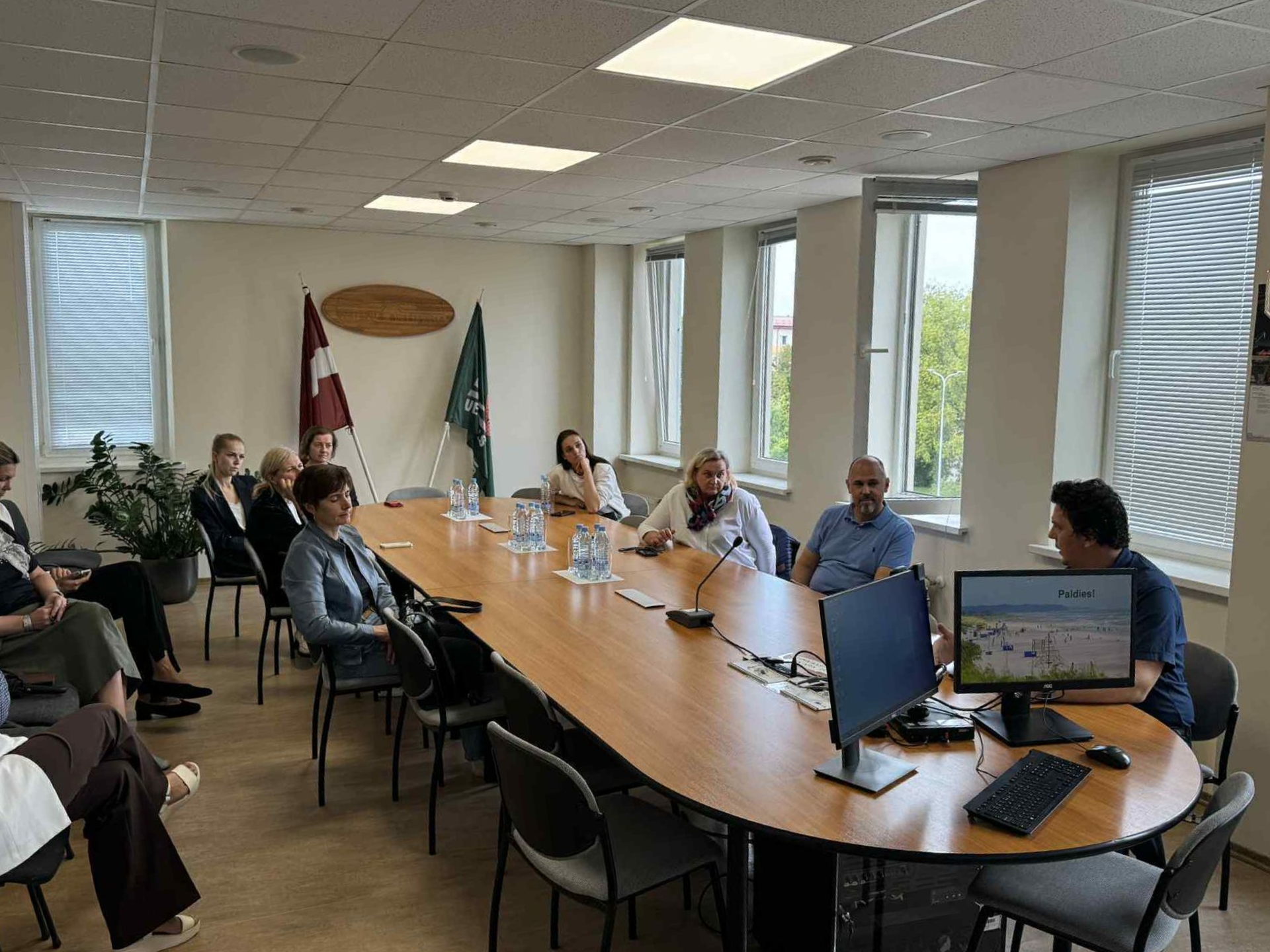
On Friday, September 12, the Latvian partners of the project “MarTe: Marine technology excellence hub for sustainable blue economy in Baltics” gathered in Ventspils. Representatives from the Ventspils Freeport Authority, the Investment and Development Agency of Latvia (LIAA), the World Wide Fund for Nature (WWF) Latvia, the Kurzeme Planning Region, the Latvian Institute of Aquatic Ecology, the association “Baltic Coasts”, and Ventspils University of Applied Sciences met to learn more about the local business environment and discuss opportunities for cooperation in promoting the blue economy. As part of the visit, the partners toured the Ventspils Freeport Authority to learn about the port’s operational areas and future development directions. They also visited the Freeport’s industrial clients, including SIA “Bio-Venta”, the largest biodiesel production and transshipment complex in the Baltic States, where partners were introduced to the company’s production processes and end products — biodiesel, rapeseed oil, rapeseed meal for animal feed, and glycerine. In addition, the partners visited the manufacturing company SIA “Aspired”, a CNC service provider, and Ventspils University of Applied Sciences to explore production capabilities and potential cooperation in human resource development. The MarTe project is focused on addressing environmental changes and fostering regional economic development. Within the project, a cross-border Centre of Excellence will be established to promote innovation, strengthen the marine value chain, and encourage the adoption of new technologies. The project’s objectives include joint research and development (R&D) activities to support the sustainable use of marine resources, strengthen ecosystems, and drive policy impact. Through quadruple-helix collaboration (linking academia, business, government, and civil society), MarTe aims to advance marine and maritime technologies, enhance stakeholder cooperation, build ecosystem capacity, bridge knowledge gaps, support SMEs and startups, and increase the visibility of blue economy innovation ecosystems in Estonia and Latvia. The project’s strategic framework focuses on coastal energy, smart ports, and marine ecosystem protection, in line with the EU Green Deal and regional Smart Specialisation Strategies. The goal of the project “MarTe: Marine technology excellence hub for sustainable blue economy in Baltics” is to develop practical solutions and policy recommendations to advance the blue economy — the sustainable use of marine and ocean resources — in Estonia and Latvia. A total of 13 organisations are involved in the project, with an emphasis on innovation in marine technologies, particularly in renewable energy, smart port development, and marine environmental protection, thereby strengthening cooperation between science, industry, public administration, and non-governmental organisations. This project has received funding from the European Union’s Horizon Europe programme, under the “Excellence Hubs” subprogramme (HORIZON-WIDERA-2023-ACCESS-07-01). The project’s lead partner is the Estonian Environmental Investment Centre (Sihtasutus Keskkonnainvesteeringute Keskus). The total project budget is €4,999,822.50, of which €367 850,00 is budget of Ventspils University of Applied Sciences. The project will run until 31 December 2028.