Students of VUAS win TechChill Students Challenge hackathon

April 14, 2023

At the end of March, three female students of the bachelor's study programme "New Enrolment Management" at Ventspils University of Applied Sciences participated in the Techchill Student Challenge hackathon, where they won the first place. The main prize - travel passes to the renowned JUNCTION hackathon in Finland - gives the students the opportunity to learn face-to-face from internationally renowned industry professionals.


 "During the three-week Techchill Student Challenge hackathon, students had the opportunity to get to know the startup environment and professionals in the field, as well as to develop an idea. "The most important thing for the start of any idea is to find a problem to solve, and we encountered this during the event itself, when we had to split into teams, which we didn't find very efficient or interesting at all. So we came up with the idea of the Crew Connect platform, which would ensure that the process of splitting teams goes well and that the teams that are created are diverse, making it all more exciting.


The project has benefited from the knowledge acquired during our studies, where we have developed an in-depth study and validation of the same product. The moment we understood WHY this product was needed, we were able to produce a well thought out idea and a clear presentation that convinced not only the other students, but also the jury."


The main prize of the competition, apart from the great experience the students gained during the hackathon, was the opportunity to go to the JUNCTION hackathon in Finland. It is a chance to experience one of the most spectacular start-up events and learn from the best people in the industry.


Thank you TechChill TechHub Riga for a great event! Congratulations to our 1st year students of Startup Management - Alisa Plotova, Selina Glaudane and Kristiana Biezuma.

Share on other platforms

Other news
By Rota Žagare September 18, 2026
On 24 September, Ventspils University of Applied Sciences will host the international scientific seminar “Massive Star Formation – Latest Research and Developments”, organised by the Ventspils International Radio Astronomy Centre (VIRAC). The seminar will bring together researchers and those interested in research with visiting scientists from the United States. The seminar will feature scientist Dr Todd R. Hunter and Lead Astronomer Dr Crystal L. Brogan from the U.S. National Radio Astronomy Observatory (NRAO). The guests will present current research in radio astronomy, state-of-the-art observational infrastructure, and the opportunities it provides for studying the Universe and the processes of star formation. Dr Todd R. Hunter will give a presentation entitled “Exploring the Universe at Centimeter Wavelengths: The Next Generation Very Large Array”, while Dr Crystal L. Brogan will present “Searching for Our Cosmic Origins Using the Atacama Large Millimeter/submillimeter Array”. The seminar will provide researchers with an opportunity to discuss the latest research findings and methods with internationally recognised experts in radio astronomy, as well as to explore opportunities for future scientific collaboration. Such international knowledge-exchange activities strengthen the research capacity of Ventspils University of Applied Sciences and promote the involvement of Latvian researchers in the international radio astronomy research community. This information has been prepared within the framework of the project “Ventspils University of Applied Sciences` International Cooperation and Innovation for the Development of Latvia’s Smart Specialisation” (Project No. 1.1.1.5/3/25/I/012). 
By Rota Žagare September 18, 2026
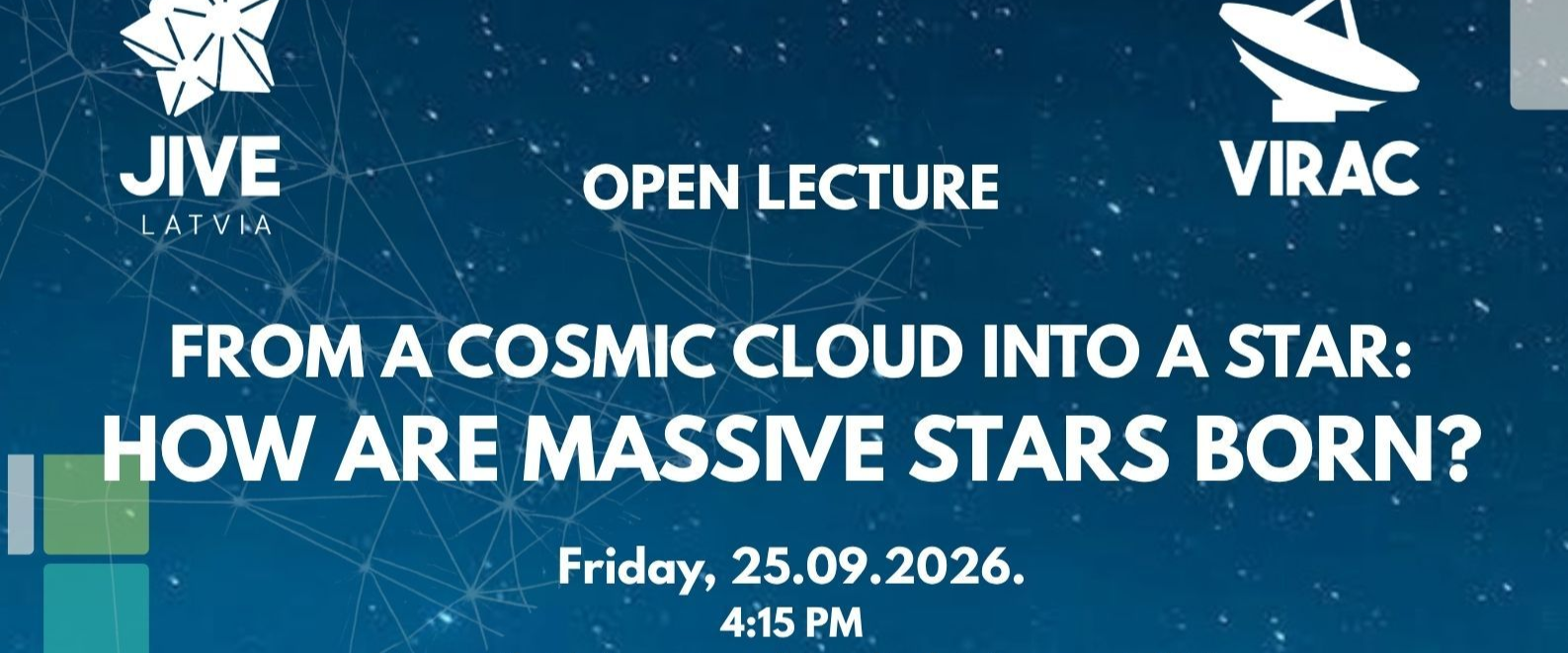
On Friday, 25 September, at 16:15, Ventspils University of Applied Sciences invites everyone interested to attend the popular science open lecture “From Cosmic Cloud to Star: How Massive Stars Are Born”. The lecture will offer an engaging and accessible introduction to how massive stars are born, how astronomers are able to observe their formation, and what these studies can reveal about the origins and evolution of our Universe. The lecture will be delivered by guests from the U.S. National Radio Astronomy Observatory (NRAO) – scientist Dr Todd R. Hunter and Lead Astronomer Dr Crystal L. Brogan. Both researchers use modern radio astronomy techniques to study star formation and processes taking place throughout the Universe. The lecture is particularly suitable for astronomy enthusiasts as well as anyone interested in space and the methods scientists use to explore the Universe. No prior knowledge of astronomy is required. The lecture will be held in English, and participation is free of charge. The open lecture will complement the European Researchers’ Night programme in Ventspils. After the lecture, participants will have the opportunity to continue exploring science at the VIZIUM Science Centre, where European Researchers’ Night activities will take place. This information has been prepared within the framework of the project “Ventspils University of Applied Sciences` International Cooperation and Innovation for the Development of Latvia’s Smart Specialisation ” (Project No. 1.1.1.5/3/25/I/012).
By Rota Žagare September 11, 2026
As the availability of artificial intelligence (AI) tools continues to grow, so do their capabilities and the range of tasks they can perform, including increasingly complex and sophisticated ones. Consequently, AI is finding applications in ever narrower and more specialised fields. Scientific research in astronomy is no exception, including radio astronomy and related theoretical fields, which are among the areas of research pursued by scientists at the Ventspils International Radio Astronomy Centre (VSRC) of the Institute of Engineering at Ventspils University of Applied Sciences. AI is based on existing knowledge and cannot independently interpret newly generated scientific results. Nevertheless, AI-assisted data processing, generation of program code, partially repetitive data rows and other types of information, as well as the initial compilation and review of large volumes of information on a scientific topic or, for example, the operation of an existing program, can facilitate certain tasks when carried out under careful supervision and verification by a researcher. The results can, in turn, be checked using another version of an AI agent. However, these approaches do not necessarily reduce the overall amount of work or the time required to complete it. To make the most effective use of the opportunities offered by AI and to communicate this knowledge in an accessible way so that it can subsequently be learned and adopted by everyone involved in research, including members of the older generation of scientists, VSRC launched a series of seminars on the use of AI in science in autumn 2026. The series places particular emphasis on astrophysics and radio astronomy, including radio interferometric observations using the Irbene Radio Telescope (IRT) and the LOFAR network. The first seminar was led by VSRC scientific assistant Gints Jasmonts, who shared his knowledge and experience on 3 September. He provided an introduction to the world of AI and presented examples from his own work in computer science and astrophysics. The discussion focused primarily on large language models available through chat interfaces, search engines and programming environments. At their core, these AI systems operate by predicting the next word or token based on the preceding context. The seminar concluded with a discussion, which revealed that participants are already using AI in their everyday work. At the same time, it became clear that learning how to apply the diverse capabilities of AI specifically to research will require further learning. The next seminar will therefore have a more practical focus. This information has been prepared within the framework of the project “Ventspils University of Applied Sciences` International Cooperation and Innovation for the Development of Latvia’s Smart Specialisation ” (Project No. 1.1.1.5/3/25/I/012).
By Rota Žagare August 31, 2026
Dr. Artis Aberfelds, Senior Researcher at the Engineering Research Institute "Ventspils International Radio Astronomy Centre" (VIRAC) of Ventspils University of Applied Sciences, participated in the prestigious international symposium "SFB 1601: Cologne-Bonn Symposium on the habitats of massive stars across cosmic time" held at the University of Cologne, Germany. A scientific report on methanol maser activity around forming massive stars was presented during the event. Organized by the University of Cologne, the symposium brought together leading astrophysicists and radio astronomers from around the world to discuss the latest discoveries in star formation, the interstellar medium, and the physical processes governing the birth of stars. The research presented by Dr. Aberfelds was developed in close international collaboration with researchers A. Sanna and L. Moscadelli from the Italian National Institute for Astrophysics (INAF). Utilizing the Karl G. Jansky Very Large Array (VLA) in the USA – one of the world's most sensitive radio telescope arrays – the study analyzed the connection between 6.7 GHz methanol (CH3OH) maser emission, stellar radiation, and outflows from young massive stars. Key Findings and Conclusions: Discovery of 5 new maser sources: Observing 22 star-forming regions, 6.7 GHz methanol maser emission was detected in 13 objects, revealing 5 previously unknown maser sources. Precise indicator of stellar location: Over 90% of all detected maser spots are located in close proximity to the central star. Direct link with thermal free-free radio continuum emission: The study revealed a strong correlation between methanol maser luminosity and thermal radio emission, enabling astronomers to more accurately predict and identify weak radiation sources in the Universe in the future. Potential for next-generation radio telescopes: Calculations indicate that more than 30% of the methanol maser population currently remains undetected due to sensitivity limits of existing instruments. These sources will be unlocked by next-generation radio interferometers (such as the ngVLA and SKA). The research and conference participation were carried out within the framework of the Latvian Council of Science (LZP) Fundamental and Applied Research Project „Revealing the physical mechanism of mass ejection around young massive stars via CH3OH masers” (Project No. 1.1.1.9/LZP/1/24/044).
By Rota Žagare July 20, 2026
The Engineering Research Institute "Ventspils International Radio Astronomy Centre" (VIRAC) of Ventspils University of Applied Sciences (VUAS) continues to develop its research infrastructure by implementing the project "Modernization of the Irbene Radiotelescope Complex Phase 4" (Project No. 1.1.1.2/1/25/I/005), funded by the European Regional Development Fund (ERDF) with co-financing from the Latvian state budget. The goal of the project is to enhance VIRAC as a centre of excellence of national importance with modern and sustainable scientific infrastructure. Several significant procurements and activities have been carried out as part of the project. To ensure the storage of large volumes of radio astronomy observation data, new hard drives with double the capacity were purchased using project funding for the Irbene Flexbuff data server. The Flexbuff server is used to store radio astronomy observation (typically VLBI) data. The previous data storage capacity was no longer sufficient, as both the transmission speed of observation data and the overall data volume have grown significantly in recent years. The new drives will ensure compliance with the increasing storage requirements of the EVN and CERN Tier-2. A contract has been concluded for the procurement of a six-wheeled ATV (quad bike) and its equipment. Such a mobile vehicle makes it possible to transport and test antenna, mobile satellite communication, unmanned, and floating equipment control and immunity solutions in motion. The vehicle is capable of transporting and testing research equipment in motion across the antenna complex's territory of more than 70 hectares, including forest and marsh conditions. Providing such equipment is essential for the developed systems to reach a high Technology Readiness Level (TRL) under real-world conditions. The engineering systems developed as a result of the research and tested with this vehicle have high dual-use potential. In May 2026, a MIG/MAG semi-automatic welding machine with the necessary peripherals and a set of materials suitable for welding aluminum and its alloys was purchased. The equipment is required for manufacturing feed systems for the RT-32 and RT-16 radio telescopes in order to expand their reception bands and promote new radio astronomical observations. As part of the modernization project, a procurement for the photogrammetry and alignment of the RT-32 radio telescope antenna surface will soon be concluded to improve surface accuracy, sensitivity, and performance at higher frequencies. Currently, the efficiency of the RT-32 antenna reaches only 35–38%, and in the highest frequency bands, it is even lower, making observations practically impossible. Photogrammetric measurements will make it possible to precisely determine the necessary position corrections for each primary mirror panel and adjust the panel mountings accordingly, reducing antenna surface error. Following the antenna surface alignment, the sensitivity, measurement accuracy, and observation capabilities of the radio telescope will improve significantly across all operating frequency bands. Taking into account that on December 15, 2025, a positive decision was received from the European Commission regarding amendments to the European Union Cohesion Policy Programme for 2021–2027, granting flexibility funding for its implementation, contract amendments for the project "Modernization of the Irbene Radiotelescope Complex Phase 4" were signed in July of this year. An additional EUR 79,151 was allocated, of which 85% is ERDF funding and 15% is Latvian state budget co-financing. With the additional funding granted, further procurements are planned within the project for the development of VIRAC's research infrastructure: purchase and installation of spare asynchronous electric motors and their control systems required to ensure the sustainability of the motor drives for the RT-32 and RT-16 radio telescopes; purchase of systems necessary to ensure the sustainability of the RF chain and control systems for the RT-32 and RT-16 radio telescopes; and the purchase of a portable handheld vector network analyzer with a bandwidth of at least up to 26.5 GHz. The EU financial support received under the project "Modernization of the Irbene Radiotelescope Complex Phase 4" (No. 1.1.1.2/1/25/I/005) strengthens VIRAC's capacity to conduct high-quality radio astronomical observations and develop new, dual-use research competencies, while ensuring the sustainability and international competitiveness of the Irbene Radiotelescope Complex. Prepared by: Arita Rubīna Public Relations Specialist for the Project
By Rota Žagare June 29, 2026
How is the Baltic blue economy changing – and what kinds of technologies, skills and decisions are needed to support its sustainable future? MarTe has published a new collection of webinar and workshop recordings on YouTube. The videos bring together researchers, industry experts and public sector representatives from Estonia and Latvia to discuss the future of the Baltic blue economy from two perspectives: the bigger strategic picture and practical technology tools.
Other news