Ventspils University of Applied Sciences develops a space weather monitoring approach based on geomagnetic observation data
Modern geophysical science is currently experiencing a renewed interest in the long-term dynamics of the Sq-components (solar quiet daily geomagnetic variation) of the geomagnetic field, and this is no coincidence. The scientific community has recognized that Sq-variations are much more than mere "background daily ripples" in magnetometer data. They have proven to be the key to understanding processes previously considered disparate: from solar-terrestrial relations to climatic trends and the dynamic evolution of the ionosphere.
1. Sq-variations as a unique long-term indicator of the state of the ionosphere and thermosphere Sq-components are generated by currents in the ionospheric E-region, which means they directly reflect:
- Plasma conductivity.
- The dynamics of thermospheric winds (the upper layer of the Earth's atmosphere, approximately 80 to 600 km, where temperatures rise to extremely high values due to the absorption of solar ultraviolet and X-ray radiation).
- The level of solar ultraviolet radiation.
- The structure of atmospheric tides in the Earth's upper atmosphere.
This makes Sq-variations a natural archive of the upper atmosphere's state, which can be studied over multi-decadal scales using data from magnetic observatories. Today, as climatic and atmospheric changes accelerate, the Sq-curve has become a crucial tool for tracking long-term trends.
2. Growing interest in solar-terrestrial relations and space weather as a global "geospace": Modern infrastructure—satellites, navigation systems, power grids – is highly sensitive to severe geomagnetic disturbances. Sq-variations:
- Serve as a baseline for the quiet state of the magnetic field.
- Enable the detection of hidden changes in the solar wind.
- Help assess the frequency and intensity of disruptions to the normal rhythm of ionospheric currents.
The long-term dynamics of Sq-components reveal how the interaction between the Earth and the Sun evolves over decadal scales, encompassing solar activity cycles.
3. Access to century-long magnetic data: The digitization of observatory archives (Greenwich, Potsdam, Irkutsk, Mikhnevo, etc.) has opened the possibility to:
- Analyze Sq-variations over a period of more than 100 years.
- Compare epochs of different solar cycles.
- Study the impact of major geophysical events (e.g., superstorms).
This has created an entirely new stratum of research: historical geomagnetic climatology.
The present example demonstrates the long-term evolution of the solar quiet daily (Sq) variations of the geomagnetic field based on data from the Bulgarian geomagnetic station Panagjurishte (Geophysical Institute of BAS, Sofia - Bulgaria). The data (Figure 1) represent time series of geomagnetic field variations for the year 2025, in form of individual geomagnetic field components (X, Y, Z) as well as the total geomagnetic field induction (utilizing modern high-precision magnetometers manufactured in Denmark and Canada).
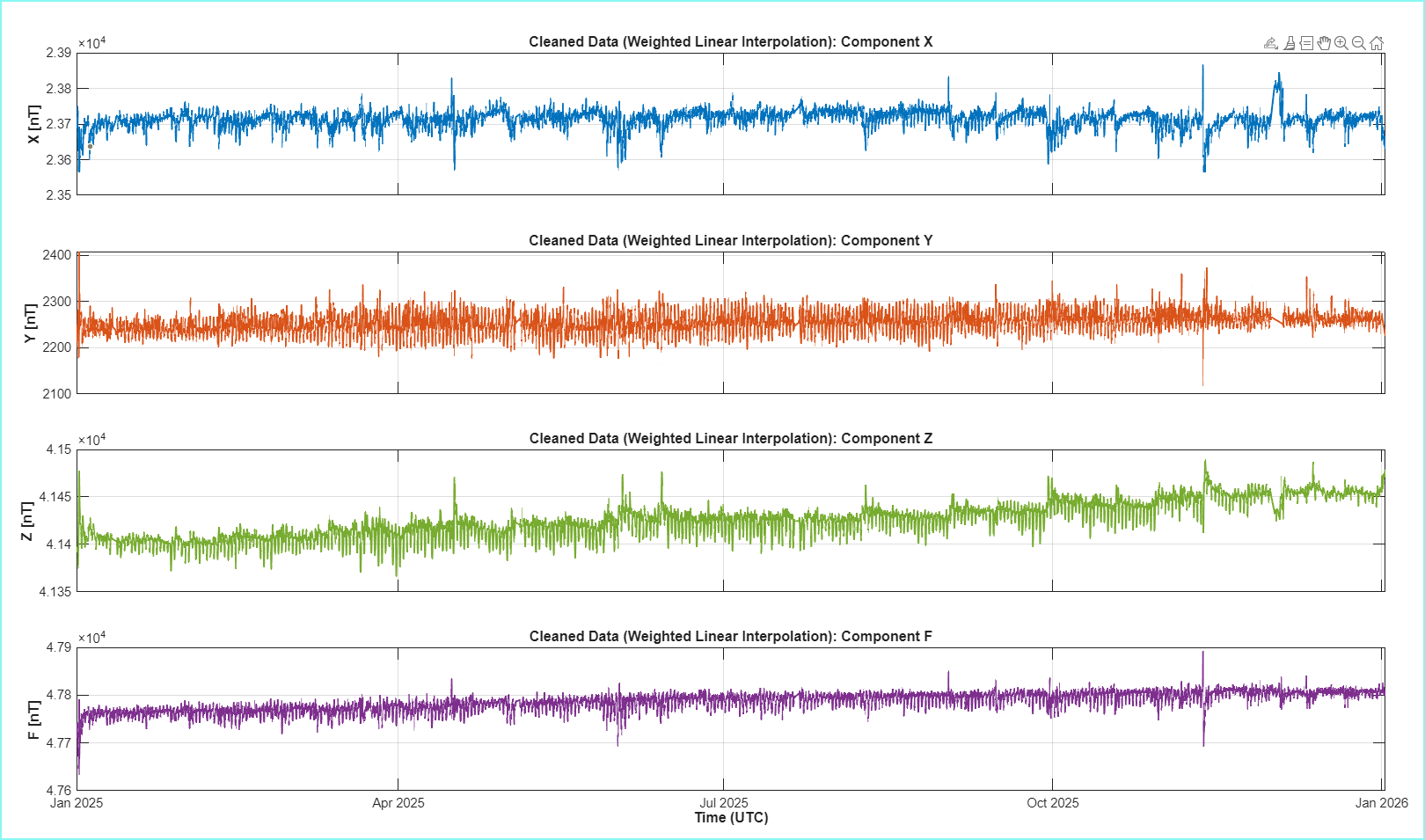
Initial interpolated geomagnetic field data (after the removal of interference and noise spikes) for 2025, Panagjurishte Magnetic Observatory (Bulgaria).
The pattern of time-frequency spectra in the 2–48 hour range is almost entirely determined by two factors: the ionospheric dynamo (regular currents) and magnetosphere-ionosphere interaction (magnetic storms) (Figure 2). The data analysis consisted of three stages: cleaning the magnetograms of interference and noise spikes; interpolation and filtering (using a Butterworth bandpass filter, which yields minimal edge effects and almost no "false ringing" artifacts); and constructing time-frequency wavelet spectra based on the Morlet wavelet function.
Main resonance (24 hours): The brightest and thickest red band across all components. It is caused by the global current system in the ionospheric E-layer (at an altitude of 100–120 km). Solar radiation ionizes the gas on the dayside of the Earth, while high-altitude winds move this plasma across the magnetic field, generating giant current vortices. Bulgaria is located relatively close to the focus of the northern Sq-vortex, which is why diurnal fluctuations are highly pronounced here.
Harmonics (12 and 8 hours): The clearly visible bands at 12 hours and, slightly weaker, at 8 hours correspond to semidiurnal and 8-hour thermal atmospheric tides. The atmosphere is heated unevenly, resulting in "tidal waves" that modulate the ionosphere's conductivity and give rise to these harmonics.
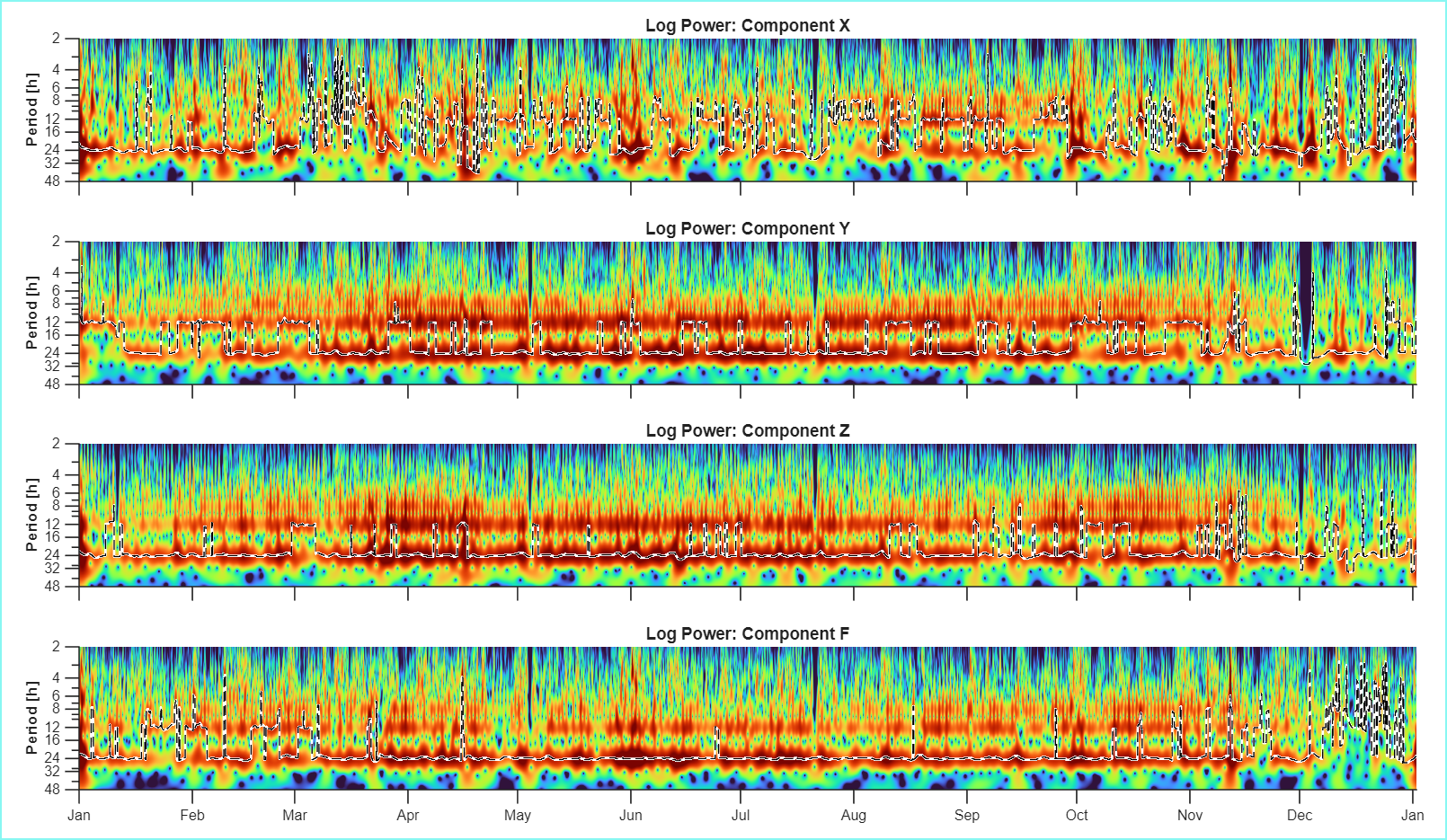
Wavelet spectrum of the filtered geomagnetic field data in the 2–48 hour period band, designed to isolate the harmonics of solar quiet daily variations for 2025, for the geomagnetic field components X (northward), Y (eastward), Z (vertical), and F (total geomagnetic field induction). The period scale is in hours. The lines on the spectra indicate the periods of the spectral power maxima and their transitions.
In this example, the primary energy of the magnetic variations is concentrated in the 24-hour, 12-hour, and 8-hour harmonics. It is evident how geomagnetic disturbances cause distortions in the periods of the solar quiet daily variations, specifically through disruptions to the structure of ionospheric electric currents. During periods of a quiet Sun, the line of spectral maxima remains steady at 24 hours. Upon the impact of a magnetic storm, the spectrum becomes "cluttered" with intense short-period noise, the dominant energy shifts, and the line of maxima abruptly drops (to 12, 8, or even 4 hours). The greater the number of such fractured segments in the spectral skeleton, the more disturbed the geomagnetic environment.
X-component (North-South): The line of maxima here "breaks" much more frequently, and the background noise between the harmonics is higher. The X-component is directed poleward and is highly sensitive to the equatorial ring current. Any magnetic storm (even a minor one) introduces a significant contribution to the X-axis, overpowering local ionospheric effects.
The Baltic region is a highly sensitive zone for ionospheric disturbances. Seasonal and latitudinal effects are pronounced here, making local observations of the geomagnetic field essential. The methodologies derived from the Bulgarian geomagnetic monitoring will be utilized to analyze data from the Latvian AlphaLab magnetometer in Irbene at the VIRAC radio astronomy observatory, serving as the first steps toward establishing a Latvian space weather monitoring system.
The above-mentioned activities were carried out within the framework of the research application “Studies of space weather conditions during the 25th solar cycle observed along the Struve Geodetic Arc”, No. 1.1.1.9/LZP/1/24/048. The application is implemented within Project No. 1.1.1.9/1/24/I/001, co-financed by the European Regional Development Fund.
Share on other platforms
Other news