New Window into the birth of massive stars: The IVARS Project Demonstrates High-Cadence Radio Monitoring of Massive Protostars

January 26, 2026

An international team of astronomers has successfully completed the IVARS (Interferometer for Variable Astrophysical Radio Sources) project, delivering a new observational capability for studying the formation of massive stars through time-variable radio emission. By combining two radio telescopes at the Irbene Radio Observatory in Latvia into a dedicated single-baseline interferometer, the project has enabled the first sustained, high-cadence monitoring of radio continuum variability in high-mass protostars, carried out simultaneously with maser monitoring.
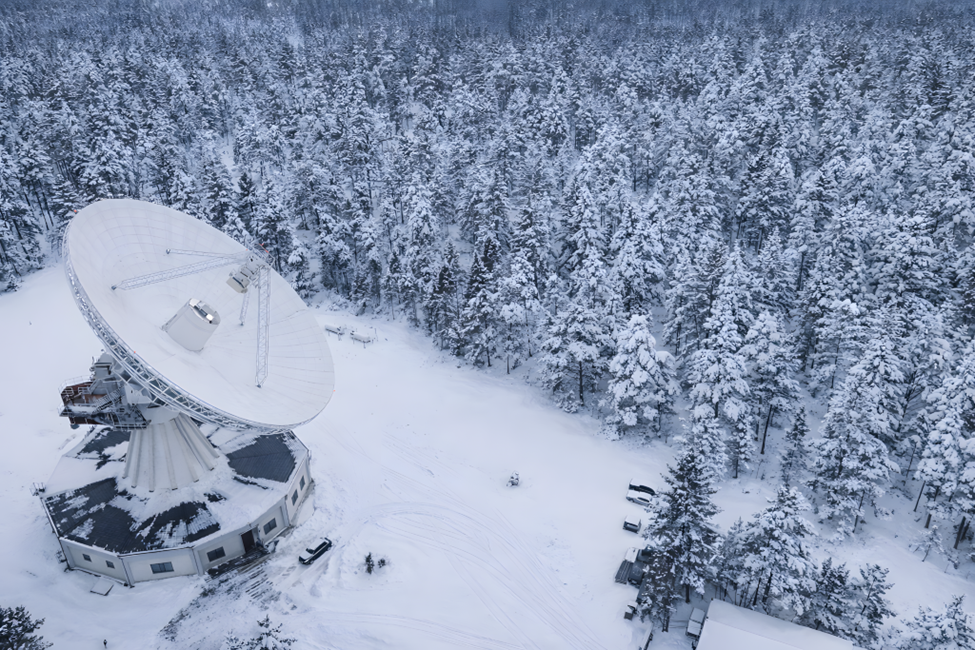
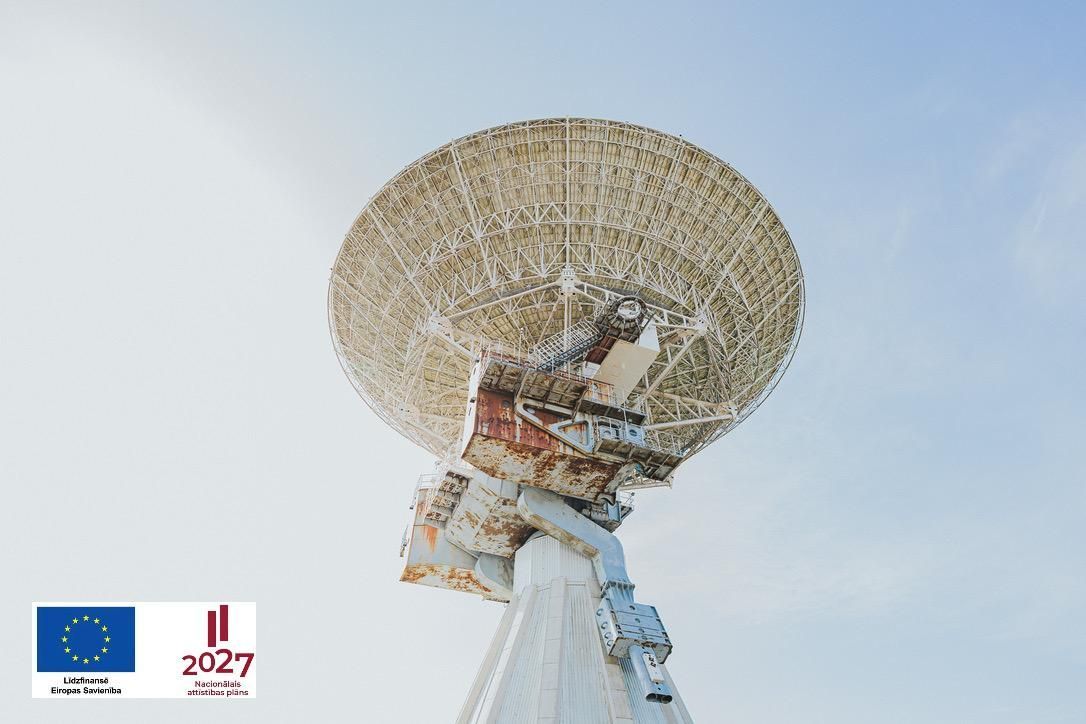
Irbene RT-32 antenna (Photo by Roberts Rasmanis)

High-mass stars shape the evolution of galaxies through their radiation, winds, and eventual supernovae, yet their formation remains poorly understood. Growing evidence suggests that these stars do not grow steadily, but instead undergo episodic accretion bursts. Such events leave signatures in both molecular maser emission and weak radio continuum emission, evolving on timescales from days to years. Capturing these changes requires frequent, sensitive observations over long periods which is a mode of observing that is difficult to achieve with large, oversubscribed radio telescope arrays. The IVARS project was designed to address this gap.


A dedicated interferometer for time-domain astrophysics

IVARS transformed the 32-m and 16-m Irbene radio telescopes, operated by the Ventspils International Radio Astronomy Centre (VIRAC), into an 800-m single-baseline interferometer optimized for time-domain radio astronomy. Unlike large interferometric arrays that prioritize snapshot imaging, this configuration allows repeated observations of the same sources at fixed geometries, delivering stable and repeatable measurements of weak, extended emission.


A key technical achievement of the project was the restoration and stabilization of interferometric operations through the deployment of a hydrogen maser clock and a White Rabbit time-transfer system, enabling nanosecond-level synchronization between the two antennas. This was paired with a fully automated observing, correlation, and calibration workflow, allowing the system to operate reliably over long monitoring campaigns.


Scientific highlights

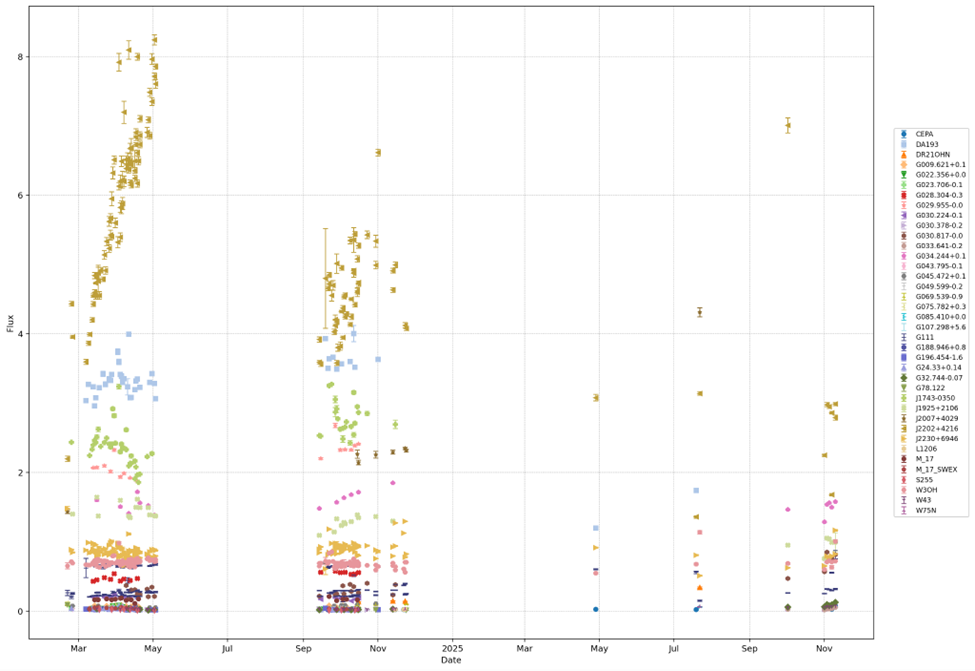
Over the course of the project, IVARS monitored a sample of 30 high-mass protostars known to host 6.7 GHz methanol masers. Of the 30 targets, continuum emission was detected in 16 sources, with 14 non-detections. Maser emission was detected in 26 targets. Maser and continuum emission were also detected in two high-mass protostars which were used as brightness calibrators.


Overall the campaign achieved several notable results:

  • Detection of radio continuum variability in multiple high-mass protostars, demonstrating that weak continuum emission (10s of millijansky) from forming massive stars can be monitored reliably at high cadence using a single-baseline interferometer.
  • Simultaneous maser and continuum monitoring, providing a unique dataset that links maser flares and continuum variability within the same sources.
  • Identification of maser flaring events, including rapid changes seen over several spectral line components consistent with episodic accretion phenomena.
  • High-resolution follow-up observations with the European VLBI Network (EVN) for selected targets, revealing disk- and outflow-related maser morphologies at milliarcsecond scales.
  • High-cadence monitoring of BL-Lac, revealing a large radio flare in the well known prototypical blazar source at very high time resolution.


Validation of automation-driven interferometry, showing that complex interferometric observing and processing can be executed with minimal manual intervention.


At present, the single-baseline radio interferometer developed by the IVARS project, represents the only infrastructure worldwide that enables high-cadence radio continuum monitoring of high-mass protostellar objects together with simultaneous maser observations.
Software and infrastructure with lasting impact

Beyond its scientific output, IVARS delivered a suite of openly available software tools. Central among these is the Automatic Correlation (ACor) system, a web-based platform that automates observation scheduling, data transfer, correlation, calibration, and quality assessment. Designed to be observatory-agnostic, ACor and the associated data-processing pipelines can be adapted by other facilities operating small interferometers.

These tools have already been adopted within VIRAC for additional science programs, including stellar flare and active galactic nucleus monitoring, and are being shared with international collaborators.


Empowering the next generation

IVARS also played a significant role in education and capacity building. Project members supervised bachelor’s, master’s, and doctoral theses, contributed to the enhancement of radio astronomy related academic and research activity at the University of Latvia, and trained students in interferometric data processing through hands-on work and international research visits. Several early-career researchers involved in the project have since progressed to doctoral or postdoctoral positions, carrying forward the expertise developed within IVARS.

Public engagement formed another pillar of the project, with team members delivering lectures, media interviews, and outreach activities aimed at secondary-school students and the general public, helping to raise awareness of radio astronomy and time-domain astrophysics.


Looking ahead

While the IVARS project has formally concluded, the pursuit of its scientific program continues. An international working group focused on single-baseline radio interferometric projects, based on IVARS, is being planned. The team is exploring how the single-baseline interferometer approach pioneered by IVARS can be replicated at other observatories worldwide, forming the basis for a broader international community focused on time-domain radio interferometry.

By demonstrating that modest-sized radio telescopes, when carefully configured and automated, can deliver unique scientific insights, IVARS has opened a new observational window on the dynamic processes governing the birth of the most massive stars in our Galaxy.


The scientific results are presented in the following publications:

  1. An Interferometer for Variable Astrophysical Radio Sources, Journal of Astronomical Telescopes, Instruments, and Systems (JATIS);
  2. Applications of the Irbene Single-Baseline Radio Interferometer, Galaxies 2025;
  3. A millimeter methanol maser ring tracing the deceleration of the heat wave powered by the massive protostellar accretion outburst in G358.93-0.03 MM1, Astrophysical Journal Letters;
  4. Search for the optimal smoothing method to improve S/N in cosmic maser spectra, Open Astronomy 2025;
  5. 6.7 GHz methanol masers in three HMYSOs: G37.43+01.51, G37.479$-$0.105 and G37.55$+$0.20, A&A (accepted for publishing)
  6. IVARS Project source monitoring summary manuscript (in preparation)


All developed software is open-source and available for use:

1) Automatic Correlation (ACor) information system (GitHub repository and ASCL.net);

2) Data Processing Pipeline;

3) Monitoring Software.


This project received funding from the Latvian Council of Science project “A single-baseline radio interferometer in a new age of transient astrophysics (IVARS)”, No. lzp-2022/1-0083.

Share on other platforms

Other news
By Rota Rulle January 15, 2026
MarTe 1st Technical Workshop “Physical Modelling for Blue & Green Transitions: Deep-Tech Tools from Lab to Market” Date: 4–5 February 2026 Venue & Format: Hybrid On-site: Ventspils University of Applied Sciences (Ventspils Augstskola) 101A Inženieru Street, Ventspils, LV-3601, Latvia Online: Zoom (with live YouTube translation) Language: English Registration: HERE About the Workshop The MarTe 1st Technical Workshop brings together researchers, industry representatives, startups, and students to explore how modern physical modelling and simulation tools can accelerate innovation in the blue and green economy . Aligned with Marine Technology Excellence Hub for Sustainable Blue Economy in the Baltics ( https://www.marinetechub.eu/ -MarTe) mission, the workshop demonstrates how deep-tech tools such as SolidWorks and COMSOL help transform early-stage ideas into real-world solutions. Through lectures, live demonstrations, and hands-on activities, participants will learn how modelling and simulation reduce development risks, shorten design cycles, and support the transition from laboratory concepts to market-ready technologies. The workshop will highlight practical applications in marine and maritime technologies, renewable energy, hydrogen (H₂-to-X) solutions, and sustainable blue economy value chains , with examples relevant to the Baltic Sea region and beyond. Programme Highlights: Introduction to physical process modelling, CAD-based modelling with SolidWorks and Multiphysics simulations with COMSOL Live demonstrations and hands-on exercises Designed for participants with little or no prior experience in 3D physical modelling. Success stories in deep-tech development from Research to Market Pathways from low TRL to market (TRL 6–7+) Who Should Attend? This workshop is open to: Industry representatives in marine, maritime, and green technologies Researchers and engineers working on applied R&I Startups and entrepreneurs in deep-tech and blue economy sectors Students and early-career innovators interested in simulation tools and applied modelling Participants will gain practical skills , insights into real success stories, and opportunities to connect with the MarTe innovation ecosystem. Why Participate? Learn modern simulation and modelling approaches Discover how to move ideas from lab to market Exchange knowledge with experts from academia and industry Build collaborations in the Baltic Sea blue economy Full agenda will be announced soon. For more information, please follow the MarTe project channels or contact the organizers. Contacts: Vladislavs Bezrukovs Vladislavsb@venta.lv Phone: +37127134283 Baiba Reimane baiba.reimane@venta.lv
By Rota Rulle January 8, 2026
Ventspils University of Applied Sciences Faculty of Translation Studies master's study programme Translation and Terminology keeps expanding its range of international partners by initiating a strategic collaboration with the Austrian company Kaleidoscope . This collaboration will provide university lecturers and students access to modern and AI-based language and terminology management tools, which are essential in today’s digital translation and terminology environment. The collaboration plans to integrate the company’s developed solutions into the study process, providing future specialists with practical skills in working with AI solutions. The Austrian company Kaleidoscope is internationally acknowledged in the field of content management. The company specializes in developing innovative software solutions that help businesses worldwide optimize the translation process and ensure terminology consistency. One of their best-known products is the AI-based platform Quickterm , which is considered as the market leader in terminology management. Kaleidoscope combines decades of experience with modern automation and quality control methods. The company’s goal is to help organizations and educational establishments communicate effectively in a multilingual environment, while reducing costs and improving content accuracy. This collaboration proves the master's study programme’s desire and ability to keep up with the latest trends in the translation and terminology industry. Students and lecturers, working with Kaleidoscope tools, will gain advantages in both the Latvian and international labor market. The first practical lessons are expected to begin in the spring semester.
By Rota Rulle December 16, 2025
On 9 December, a meeting with representatives of Latvia’s space sector was held at the Saeima, focusing on the establishment of a unified approach to the governance and development of the space sector in Latvia. The event was attended by Mārcis Donerblics, Head of the Ventspils International Radio Astronomy Centre; Andris Vaivads, Rector of Ventspils University of Applied Sciences; and Jānis Šate, Head of the “Electrical Engineering” study programme. The meeting was initiated by Saeima Speaker Daiga Mieriņa, bringing together representatives of industry organisations, entrepreneurs, education and research institutions, along with officials from public administration bodies. The purpose of the discussion was to highlight the need for a clear and coordinated governance model that would advance the sustainable development of Latvia’s space sector, strengthen inter-institutional cooperation, and assure unified representation of national interests at the international level. The meeting highlighted the role of the space sector in driving innovation, strengthening the high-tech ecosystem, and enhancing Latvia’s competitiveness. Representatives of the Latvian Space Industry Association, space sector entrepreneurs, experts from academic institutions, as well as officials from various ministries and state institutions. Participants highlighted that a unified governance approach is an essential requirement for Latvian organisations to actively participate in European Union space programmes and international cooperation projects, including collaboration with the European Space Agency. The meeting also addressed topics related to enhancing public-private sector cooperation, opportunities for attracting funding, and the importance of maintaining dialogue on the long-term development of space policy in Latvia. Participants recognised the significance of ongoing collaboration and emphasised the necessity of regular communication between policymakers and industry representatives. The meeting at the Saeima marks an important milestone toward a better-coordinated and goal-oriented Latvia’s space sector, promoting a unified vision and strengthening Latvia’s position within the European and international space community.
By Rota Rulle December 15, 2025
On December 10, at the Ventspils University of Applied Sciences Library, students and other participants with a German language knowledge had the opportunity to be a part of a German language workshop on Christmas-themed topics titled “Modernes Deutschlandbild mit Fokus – Weihnachten” and conducted by Goethe-Institut volunteer Jūlija Novodvorska ( Julia Nowodworska ). During the workshop, participants were able to introduce themselves and engage in a range of activities, including creative tasks such as making origami candle holders, singing Christmas songs in German, and enjoying traditional Christmas treats and tea. As a gift from Ventspils German Culture Society, workshop participants received the new bilingual calendar for 2026, “L ebendige Gutshöfe – gestern und heute | Manor Houses – Yesterday and Today,” which has been prepared by the Ventspils German Cultural Society for the fifth year in a row. Students from Ventspils Technical School also participated in the workshop together with their German language teacher, Žanna Blaževica. The event was an excellent opportunity to put the German language knowledge acquired during the lessons into practice. Sincere thanks to Julia for leading the workshop! The workshop was organised in cooperation with the Goethe-Institut in Riga, the Chair of the Ventspils German Cultural Society, Māra Kraule, and VUAS FoTS lecturer Silga Sviķe.
By Rota Rulle December 15, 2025
Professor at Ventspils University of Applied Sciences, researcher of the State Research Programme Una Libkovska participates in the 3rd International Scientific Conference International Conference on Advancing Sustainable Futures. Shaping the Future: Synergies Between Nature, Technology and Society On 10–11 December 2025, Professor Una Libkovska, researcher within the National Research Programme project “Development of evidence-based solutions for the effective improvement of professional competence of adults and the assessment of the transfer of its results to practice in Latvia” (VPP-IZM-Izglītība-2023/4-0001), participated in the 3rd International Scientific Conference “Advancing Sustainable Futures: Shaping the Future: Synergies Between Nature, Technology, and Society (ICASF 2025)”, organised by Abu Dhabi University and held in Abu Dhabi, United Arab Emirates. During the conference, the project’s key insights and research outcomes were presented and discussed within the scientific programme, including a paper entitled “Contribution of Sustainable Human Resource Management to Organizational Sustainability and Labour Market Transformation”. The ICASF 2025 conference brought together more than 200 participants from over 30 countries, who took part in the thematic scientific sections and presented research spanning the natural sciences, engineering and technology, social sciences, economics, and interdisciplinary studies, addressing global challenges and solutions related to sustainable development. Participants represented Europe, Asia, North America, and Africa, including Latvia, the Netherlands, Poland, Italy, the United Kingdom, France, Lithuania, the United States, Canada, India, Japan, and other countries. Participation in the conference provided valuable opportunities to expand international research cooperation, strengthen institutional partnerships, and engage in global dialogue on shaping a sustainable future. It also enabled the validation of research results within a broad international academic audience and supported knowledge transfer related to sustainable development policy, professional competence development, and the challenges of lifelong learning. 
By Rota Rulle December 15, 2025
On 5 December, the Latvian Association of Young Researchers (LJZA) marked its 20th anniversary with a celebration event at the Riga Latvian Society House. The anniversary event, held in the Golden Hall of Riga Latvian Society House, gathered together representatives from different generations of the LJZA, as well as the association’s supporters and partners. During the anniversary celebrations, young scientists were honoured for their active involvement in the LJZA Policy Working Group. Thus, VUAS doctoral student Džeina Kleina-Šnipke from the study programme “Economics and Business” received recognition for her contributions to the policy working group and doctoral student Aiga Bādere from the study programme “Languages and Literature Studies” received recognition for translating and editing LJZA texts. Throughout the ceremonial event, the association’s origins, development and achievements were reviewed, and active members and cooperation partners were honoured for their support, which has allowed the LJZA to strengthen its involvement in academic activities, public policy-making and science communication processes. The anniversary event in the Golden Hall of the Riga Latvian Society was attended by representatives of different generations of the LJZA, described in a congratulatory speech by one of the association’s founders, Jānis Jaško, as both “older” and “younger” young scientists, along with the association’s supporters and cooperation partners. Over the years, the association has been supported both intellectually and financially by the Minister of Education and Science, the Saeima of the Republic of Latvia, the Latvian Council of Science, the Latvian Academy of Sciences, the National Electronic Mass Media Council, and other institutions. Photo by: Dāvis Dambenieks
Other news