One of us: Kristaps Kučers

November 4, 2020

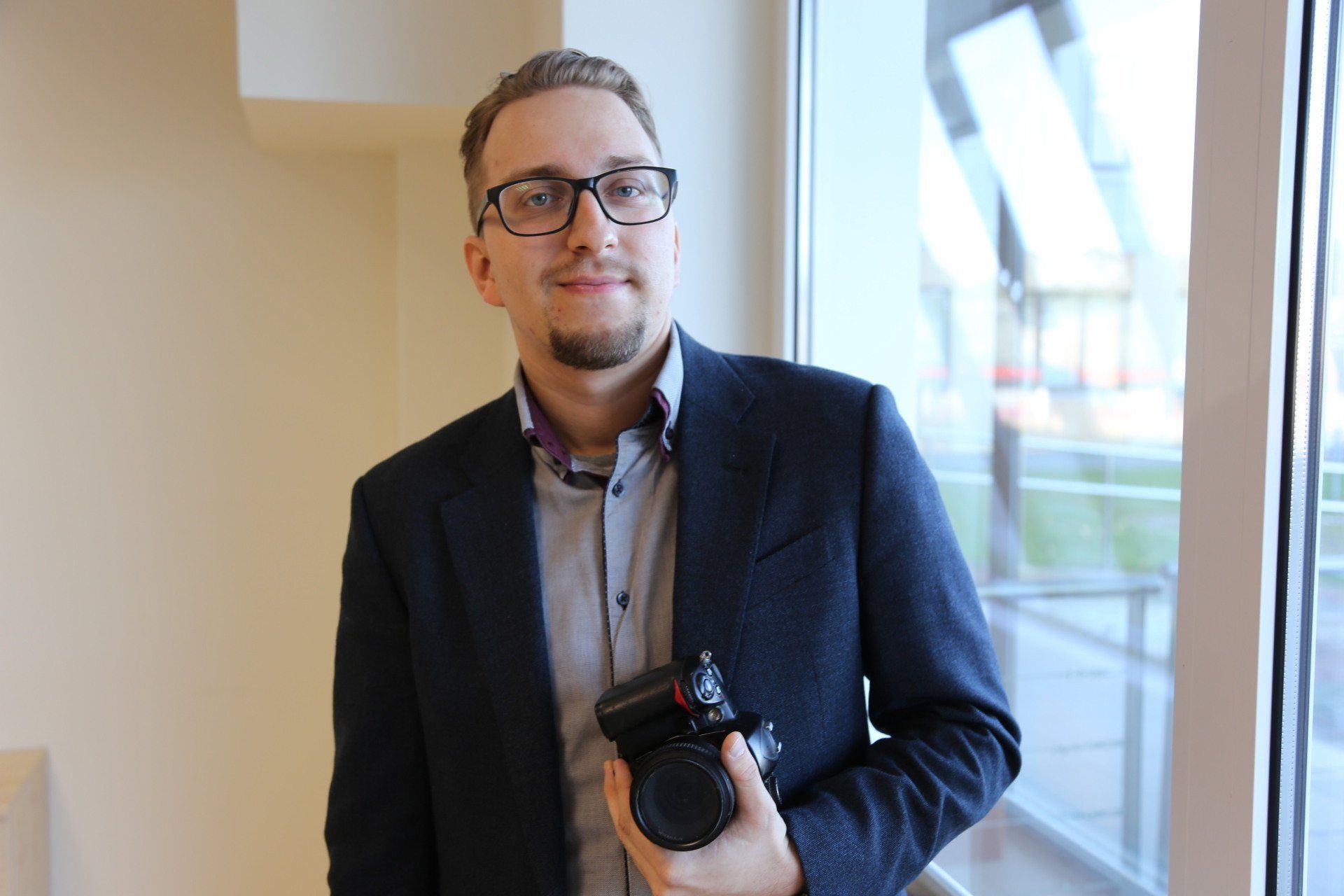
Kristaps is Ventspils University of Applied Sciences (VUAS) student, employee and a participant of the project “Kurzeme Innovation Grants for Students” (KInGS). He is also an enthusiastic photographer who in the future wants to take photography to a more professional level. Kristaps is sharing his experience and he is certain that we should believe in our dreams and more importantly - we should make them come true!


Hi, Kristaps! Tell us about yourself - where are you from and what do you do?


Hi, I've been living in Ventspils for already two years but for many years I have studied and worked in Rīga and Jelgava. However, I grew up in Talsi – so not that far away from Ventspils. Currently I study in Ventspils University of Applied Sciences Master Study Programme “Business Management” – I am in the second and last year. After a successful internship here in the university I started working in Ventspils University of Applied Sciences Research and Development Department. I also coordinate projects and work on making the university technologically progressive. 


Do you have any hobbies?

I could mention many hobbies – I enjoy trying new things, but photography and video recording are the ones I've been doing for the longest time. If I remember correctly, for 8 years I've been taking photographs of my friends and relatives, sometimes I take photographs of events and record some adventures. Just like any real hobby it requires endless investments, that's why this hobby has been transferred to a more professional level by developing a business related to photography and videos. I could say that it is my new hobby to try to develop a business around some of my hobbies. 


What is your business idea and how did you create it?
My idea is to develop a video recording stabilization system – for balancing steps, shaking of hands and other movements that make the video look like it's shaking. The existing market for this kind of tripods is more suitable for professionals. Whereas, for people like me who do this as a hobby, it is difficult to justify such high costs. I have had the idea to build a tripod since I started recording videos and realised that it is difficult to record a quality video when recording with a hand-held camera. Back then it wasn't possible for me to buy an already made system because a high quality system costs more than my basic equipment. Even though the price has gone down over the years a professional stabilization system still costs just as much as a camera. Just like any practical Latvian I had an idea to make it myself. Firstly, it would give an opportunity to order components and necessary details separately and pay partly. Also the total sum would be lower, however, since I was living a student life I never had a chance to do that. I was dreaming of creating a tripod every time I had an opportunity to record something interesting. I had an idea to create it not just for me but for everyone who does video recording on a hobby level. When studying and working in Ventspils University of Applied Sciences I had a chance to participate in KInGS project and I just had to take it so that I could finally make one of my dreams come true and also start my own business.


Why did you decide to participate in the project “Kurzeme Innovation Grants for Students?”


The word “scholarship” spoke to me, just like to any real student. When I found out about the benefits of the project I didn't have any more doubts whether to participate or not. The opportunity to receive a grant for product development, engage other skilled students, receive training and different types of support - an excellent starter pack to create a business and get to know entrepreneurship in practical ways without “burning” your own resources.


What do you expect from KInGS project?


The big goal of course is to start my own business. But more valuable gain will be the skills acquired during these 6 months. Skills to present, analyse data, plan my own and others` time, communicate. Not to mention business skills - defining target audience, planning finances, MVP or even developing a finished project. It is not about the accomplishments of the project - here we can talk about the added value you can take from the project, which will help you to perfect the planned idea and also help developing new ideas in the future.


What is your life motto?


I`ve never really defined my motto. But if I think about it I remember a quote from a sports film - “If you fall, you have to get back up, dust yourself off and try again - you can't give up!” Even though this quote is about failures in sports, if I had to formulate my motto it would also relate to everything else in my life. If something doesn't work out, you can't give up. You have to get yourself together and try again and again.


Share on other platforms

Other news
By Rota Žagare April 29, 2026
At Irbene and Riga, 20–21 April 2026, a significant international scientific and academic event - the strategic seminar “Latvia’s National Partnership within LOFAR ERIC”- was held in Latvia, bringing together leading European radio astronomers, national policymakers, and academic institutions to strengthen Latvia’s long-term involvement in the LOFAR ERIC (Low Frequency Array – European Research Infrastructure Consortium) network. The meeting marked an important step in building a coordinated Latvian LOFAR community, bringing together Ventspils University of Applied Sciences, Riga Technical University, the University of Latvia, alongside other Latvian universities, and supporting stronger collaboration in radio astronomy, data science, and related technologies. Keynote presentations were delivered by Prof. Peter T. Gallagher (Ireland), Chair of the LOFAR-ERIC Council, and Prof. Michiel van Haarlem (Netherlands), Executive Director of LOFAR-ERIC. They were joined by directors of international LOFAR stations and leading experts from Ireland, the Netherlands, Sweden, France, Bulgaria, and Poland, as well as representatives from Latvia’s Ministry of Education and Science, the Ministry of Economics, and universities. Discussions focused on Latvia’s future participation in LOFAR-ERIC, highlighting its strategic location, research capabilities, and growing role in European research infrastructures. A central outcome is a shared commitment to fostering a national LOFAR consortium and strengthening Latvia’s integration into European research programmes. The event brought together researchers, early-career scientists, and students, underlining Latvia’s growing appeal in astrophysics and space research, as well as LOFAR’s broad scientific impact across signal processing, big data analytics, and machine learning. On 20 April, participants visited the Ventspils International Radio Astronomy Centre (VIRAC) in Irbene, where they toured the RT-32 radio telescope and the LOFAR Irbene station (LV614), gaining insight into Latvia’s radio astronomy infrastructure and recent technological upgrades. The meeting confirmed strong momentum toward establishing a cohesive national LOFAR ecosystem in Latvia, supported by close cooperation between universities, government institutions, and international LOFAR-ERIC leadership. The event was organised as part of the project “International Cooperation and Innovation of Ventspils University of Applied Sciences for the Development of Latvia’s Smart Specialisation” (Project No. 1.1.1.5/3/25/I/012).
By Rota Žagare April 29, 2026
We are excited to invite you to the annual VUAS Culture Days 2026 – an interactive event organised by 1st year Intercultural Communication students. This years' topic: Cultural Minefield: Step Carefully Explore the unspoken rules of culture and test your instincts in real-life situations. During the event, you will: Take part in interactive quizzes Engage with real-life cultural scenarios Gain practical cultural insights You will also hear from representatives from Croatia, Ukraine, Germany, India, Turkey, Latvia and Ghana, who will share cultural taboos, etiquette rules, and common “tourist mistakes”. Bonus for the on-site participants: “The Flavor of My Culture” table. Participants are warmly invited to bring a homemade dish or drink that represents their culture and share it with others. When? May 6 At what time? 16:00 (EEST) (3:00 PM CET) Where? Room D0 and online – https://us02web.zoom.us/j/89909358229 This event is designed to be practical, engaging, and memorable – whether you are preparing for international experiences or simply curious about cultural differences. In order to participate, please register here: https://forms.gle/pR9QvZirzf3nwne97
By Rota Žagare April 29, 2026
On April 24, Ventspils University of Applied Sciences welcomed Deputy Head of Mission from Embassies of Denmark (Alexander Lemche), Lithuania (Vilius Arlauskas), and 1 st Secretary at the Swedish Embassy Hugo Qvinth for a guest lecture that brought global perspectives directly into the auditorium. The diplomatic representatives engaged with students in an open discussion on diplomacy, international cooperation, and the realities of representing one’s country on the global stage. The visit highlighted the strength of the Nordic-Baltic partnership, often referred to as the NB8, which is an informal yet highly integrated cooperation network of eight countries united by shared democratic values and a commitment to collaboration. As emphasized during the lecture, this alliance of 33 million people demonstrates how countries can achieve more together than alone, becoming not only stronger internally but also more influential internationally. Students were introduced to the idea that diplomacy is not just about politics, but about people, communication, and responsibility. The diplomats spoke openly about their career paths, stressing that there is no single “correct” background for entering diplomacy. Instead, curiosity, initiative, and a willingness to step outside one’s comfort zone are the key factors. A recurring theme throughout the session was courage. Students were encouraged to ask questions, seek international experiences, and remain open to change. “Everything comes from curiosity,” Vilius Arlauskas noted, highlighting the importance of exploration both professionally and personally. The discussion also addressed the realities behind the diplomat's profession. Diplomacy requires adaptability, resilience, and the ability to navigate complex global challenges. From balancing personal life with a demanding international career to representing national interests with precision and responsibility, the speakers provided an honest insight into both the rewards and challenges of the field. Beyond career advice, the guest seminar emphasized the power of communication. Understanding one’s audience, preparing strong arguments, and delivering clear and precise messages were highlighted as essential skills not only for diplomats, but for anyone working in an international environment. As Hugo Qvinth emphasized, “for a diplomat, the most important thing is to know many languages”, highlighting how language serves as a bridge between cultures and people. The event concluded with an interactive Q&A session, where students had the opportunity to engage directly with the diplomats, ask questions, and gain personal insights. The atmosphere remained open, encouraging, and genuinely inspiring which left many students motivated to explore international careers and opportunities.  This visit served as a powerful reminder that diplomacy is not distant or abstract – it is built on human connection, curiosity, and the courage to step into the unknown. Written by: Elizabete Apiņa-Fleisa (BSP “Intercultural Communication”, 1st year)
By Rota Žagare April 28, 2026
Last week, the European Student Assembly 2026 (ESA26) took place at the European Parliament in Strasbourg – one of the most significant student participation events in European higher education. It brought together students from across Europe to jointly develop recommendations for the future development of Europe. At the assembly, Ventspils University of Applied Sciences (VeA) and the COLOURS European University Alliance were represented by student Liene Rozenberga. In total, 2,889 applications were submitted to participate in ESA26, but only 250 students were selected, representing 54 university alliances, 195 universities, 34 countries, and 54 different nationalities. Among them was Liene Rozenberga, a student in the “Business Administration” bachelor’s program at VUAS. She represented the COLOURS alliance and worked in the subgroup “Democracy and Civic Engagement.” This panel focused on how to strengthen citizen participation in democratic processes within the European Union (EU) and promote clearer, more accessible language in EU-issued regulations. “Participating in the European Student Assembly gave me the opportunity to actively engage in discussions at the European level about the future of democracy. It made me even more aware of how important the voice and perspective of young people are in decision-making,” said Liene Rozenberga. The work of ESA26 was organized into eight major thematic groups, each tasked with developing 10–12 recommendations on issues not yet sufficiently addressed in EU legislation and regulatory frameworks. Work on these recommendations began back in January, when participants collaborated in teams, attended training sessions, and consulted experts. Meeting in person in Strasbourg, participants refined and presented their proposals and ultimately voted on their adoption. “We had many discussions about how to involve EU citizens in decision-making. Our goal was to create practical and implementable recommendations that could complement the existing EU policy framework. I worked on recommendations related to developing an action plan for media literacy and combating disinformation in the EU,” the student explained. At the end of the event, all recommendations were presented in a plenary session of the European Parliament, where students voted on their adoption. This process not only tested the quality of the ideas but also allowed participants to experience a real democratic decision-making process in an international environment. Participation in ESA26 provided Liene not only with academic and professional experience but also with valuable connections and the opportunity to represent both VUAS and Latvia at the European level. This experience once again confirms that the student voice matters in shaping Europe’s future, and that VUAS students are ready to be part of this process.
By Rota Žagare April 22, 2026
We invite you to participate in the guest lecture "Public Engagement in Civil Protection." The Representation of the European Commission in Latvia offers the opportunity to attend this lecture, which will be delivered by guest lecturer Inese Vaivare, Director of LAPAS, Head of the NGO Civil Protection Working Group of LPA, and Head of the Baltic Sea Civil Protection Network BSR-NOVA. Date: May 5 Time: 16:15–17:45 Language: English Location: Online ZOOM meeting Meeting ID: 984 9439 2957 Passcode: 773257
By Rota Žagare April 20, 2026
On April 14, Professor Una Libkovska and doctoral students Monta Anšica and Zane Zonberga of Ventspils University of Applied Sciences participated in the 84th International Scientific Conference of the University of Latvia within the framework of the State Research Programme project “Elaboration of evidence-based solutions for effective professional competence development of adults and assessment of the transfer of its results into practice in Latvia” (VPP-IZM-Izglitiba-2023/4-0001). During the conference session titled “Key Aspects of Entrepreneurship and Management in Strengthening Global Competitiveness,” the results of the study were presented and a report was delivered on the topic “Strategic Management Competencies and Their Impact on Organizational Competitiveness.” The conference section was intended as a platform for scientists, researchers and practitioners to share ideas, insights and research on current issues of sustainable development. It addressed a wide audience, from academic researchers to representatives of companies and the public sector. All speakers were invited to participate in original studies, situational analyses and experiential stories. Scientists, experts, entrepreneurs and academics from different countries participated in the discussions, promoting international exchange of experience and cooperation. The conference paid special attention to the development of education and human capital, the introduction of science-based innovations, attracting investments and the development of competitive projects in Latvia and Europe.
Other news